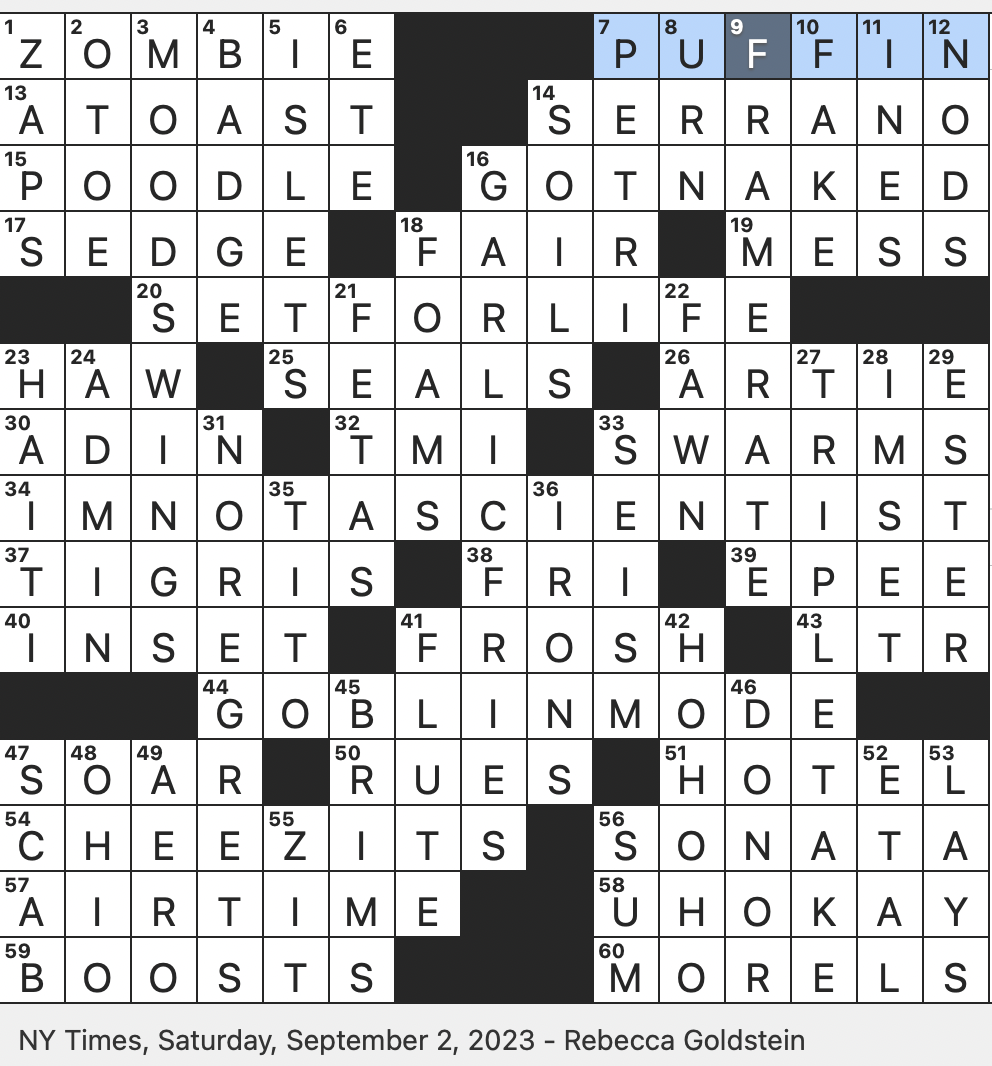
Word of the Day: FRAME RATE (9D: Cinematic specification) —
Frame rate (expressed in frames per second or FPS) is typically the frequency (rate) at which consecutive images (frames) are captured or displayed. This definition applies to film and video cameras, computer animation, and motion capture systems. In these contexts, frame rate may be used interchangeably with frame frequency and refresh rate, which are expressed in hertz. Additionally, in the context of computer graphics performance, FPS is the rate at which a system, particularly a GPU, is able to generate frames, and refresh rate is the frequency at which a display shows completed frames. In electronic camera specifications frame rate refers to the maximum possible rate frames could be captured, but in practice, other settings (such as exposure time) may reduce the actual frequency to a lower number than the frame rate. [...] Early silent films had stated frame rates anywhere from 16 to 24 frames per second (fps), but since the cameras were hand-cranked, the rate often changed during the scene to fit the mood. Projectionists could also change the frame rate in the theater by adjusting a rheostat controlling the voltage powering the film-carrying mechanism in the projector. Film companies often intended that theaters show their silent films at higher frame rates than they were filmed at. These frame rates were enough for the sense of motion, but it was perceived as jerky motion. To minimize the perceived flicker, projectors employed dual- and triple-blade shutters, so each frame was displayed two or three times, increasing the flicker rate to 48 or 72 hertz and reducing eye strain. Thomas Edison said that 46 frames per second was the minimum needed for the eye to perceive motion: "Anything less will strain the eye." In the mid to late 1920s, the frame rate for silent film increased to between 20 and 26 FPS. [...] When sound film was introduced in 1926, variations in film speed were no longer tolerated, as the human ear is more sensitive than the eye to changes in frequency. Many theaters had shown silent films at 22 to 26 FPS, which is why the industry chose 24 FPS for sound film as a compromise. From 1927 to 1930, as various studios updated equipment, the rate of 24 FPS became standard for 35 mm sound film. [...] Many modern 35 mm film projectors use three-blade shutters to give 72 images per second—each frame is flashed on screen three times. (wikipedia)
• • •
Little early in the season for Zombies and Goblins. Kinda like Starbucks bringing out the PSL (Pumpkin Spice Latte) in August. But having had a bat (perhaps bats, plural) in my house for the better part of two weeks (!!!) last month, I was primed for today's Halloween-esque vibes. (The bat problem appears to be dealt with now, though we are having major PTBD every night ... hearing things and seeing things in the night ... it's getting better ... sort of ...). Anyway, nothing *too* Saturday-scary about this puzzle, though it did give me a bit of a fight (if not a fright) in some of the longer answers, particularly "I'M NOT A SCIENTIST," which I found very difficult to parse. I would've liked the answer better if it had a "BUT..." on the end. As a standalone phrase, it feels slightly odd. Also, I'm not sure about the clue. "Skepticism" and "disbelief" are (importantly!) not the same thing. You should be *plenty* skeptical of scientists. It's OK. They're used to it. That's kind of the point of science. You don't take things so much on faith or trust. You require evidence. Others then can confirm what you've claimed. Further, there are plenty of reasons to trust non-scientists. In fact, I would typically use "I'M NOT A SCIENTIST" in situations where I am most certain I am right, i.e. "I'M NOT A SCIENTIST, but bleeding out of your eyes seems bad, you should maybe have that looked at." I have a hard time imagining the phrase being said without its being followed by a "but," but maybe I'm thinking "I'm no scientist, but ..." and some other context is being imagined here. Anyway, skepticism is healthy—continued disbelief in the face of mountains of evidence and overwhelming scientific consensus isn't.
I also forgot what GOBLIN term I was dealing with. I put in CORE at first (GOBLINCORE is real!). I then tried MIND (GOBLIN MIND ... like HIVE MIND, only ... goblinier). Finally realized what phrase-ending term I was dealing with (GOBLIN MODE!), which unlocked HOHOHO and DONOR and I was back into my flow around the grid ... until I wasn't, again, because I couldn't figure out what kind of TAKE was happening at 27D: Shocked reaction (TRIPLE TAKE). SPIT wouldn't fit and that ... was that. Tried to think of other reactions one might have, in six letters. SNEEZE TAKE? Do people sneeze when they're shocked, I wondered. Oy. TRIPLE. That was ... something. Lastly, where long answer troubles were concerned, I had no idea what kind of FRIES I was dealing with at Oracle Park. Am I supposed to infer GARLIC because San Francisco is fairly close to Gilroy, CA, the Garlic Capital of the World? Seems a stretch. The "RL" had me thinking not GARLIC but the creatively spelled CURLIE. Hey, if you can spell OKIE-DOKIE like that (see yesterday's puzzle), then you can sure as hell spell CURLIE FRIES like that as well. But eventually I GOT NAKED (uh, gotGOT NAKED), and thus finally got to GARLIC FRIES.
Loved how this puzzle opened—very dramatically and energetically!
Pew! Pew! We're zapping zombies right off the bat (!), nice. NO REGRETS! This puzzle's got MOOD SWINGS, and I love it! Just so much liveliness in this one. SWARMS of it. I thought this puzzle had one of the great misdirect clues of all time, but when I reviewed the puzzle after completion, I realized I'd slightly misread it. I thought OHIO was clued as [Red state], which is perfect. I mean, perfect. I was fully expecting people to show up, mad that the puzzle had pigeon-holed OHIO politically like that, only to discover that "Red" referred to a baseball player (for the Cincinnati Reds), not conservatism. But then I looked at the actual clue and "Reds" is in the plural. Not nearly so tricky. [Red state?] with a "?" would definitely have worked, and I think you can even get away with no question mark. It's pretty literal. I mean, I got it thinking that that's what it was, so I'd say that means it definitely works. [Reds state] is just too easy, and not nearly as interesting.
I think of "hear, hear!" as something say to signify agreement with a statement, not something they say before A TOAST, so that clue didn't work for me at all (13A: Words that might be followed by "Hear! Hear!") [sorry, really misread this one—the “hear, hear!” is supposed to follow “A TOAST!” I’ve never heard (heard) that, but it makes more sense that way, for sure]. It's cool that EPEEs have triangular blades, but it's less cool, to the point of annoyingly vague, that SEDGE does (17A: It has triangular blades). Not one of the more evocative doubled-up clues. I never know who has a "good name for" what, so ARTIE didn't come easy (26A: Good name for a gallery owner). I was hindered by having FRET instead of FAWN at 22D: Fuss (over), so I had the gallery owner's name starting with an "R" ... and then I wanted ROWAN ... because I confused "gallery" and "galley" ... as in the ship? ... the boat? ... Rowin' the boat ... ashore ... somehow? Yeah, that was a weird hole to fall into, I'll admit. No idea about the "LAYS of Ancient Rome," as I have no idea who Macaulay is—so that clue was fun. I assume the LAYS are poems and not potato chips (I would be very tempted to buy "LAYS of Ancient Rome" potato chips—don't even tell me the flavor, just let me guess). Lastly, shout-out to every puzzle-solving person walking the lines in the WGA/SAG strikes. You're gonna win. No SCABs! See you tomorrow.
THEME: old-fashioned slang? — no, actually, there's none. No theme.
Word of the Day: Alice PAUL (36A: Alice ___, 20th-century women's suffrage activist) —
Alice Stokes Paul (January 11, 1885 – July 9, 1977) was an American Quaker, suffragist, feminist, and women's rights activist, and one of the foremost leaders and strategists of the campaign for the Nineteenth Amendment to the U.S. Constitution, which prohibits sex discrimination in the right to vote. Paul initiated, and along with Lucy Burns and others, strategized events such as the Woman Suffrage Procession and the Silent Sentinels, which were part of the successful campaign that resulted in the amendment's passage in August 1920.
Paul often suffered police brutality and other physical abuse for her activism, always responding with nonviolence and courage. She was jailed under terrible conditions in 1917 for participating in a Silent Sentinels protest in front of the White House, as she had been several times during earlier efforts to secure the vote for women in England.
After 1920, Paul spent a half-century as leader of the National Woman's Party, which fought for the Equal Rights Amendment, written by Paul and Crystal Eastman, to secure constitutional equality for women. She won a major permanent success with the inclusion of women as a group protected against discrimination by the Civil Rights Act of 1964. (wikipedia)
• • •
Lots of whooshing around today. This grid design seems to allow for maximum whoosh. The whooshing got so extreme that there were whole long answers I never even saw the clues for. SPECIAL SAUCE? Never saw it. CALL CENTER? Never saw it. The short crosses were falling so easily, everywhere I went, that for those two answers, at some point I just looked at the grid, realized there was nothing else those answers could be, and just wrote them in. I probably had SP- and -AL SAUCE already in place when I threw that one down. I know I threw down CALL CENTER from CALL CE-. The thing about these no-looks is that they not only seem undeniable, they immediately mesh with their adjacent answers. You can tell a bad guess pretty quickly (sometimes!) by the way it clashes with its neighbors, and SPECIAL SAUCE and CALL CENTER just slid right in, obviously at home. A great and good answer, respectively, but I never had to look at the clues ... which, in the case of SPECIAL SAUCE, is probably good, because that clue is just confusing (39A: Trademark difference-maker). I guess this is referring to the generic use of the term. I always think of it as a McDonald's-specific term. I wonder if the term ever existed before "two all-beef patties SPECIAL SAUCE lettuce cheese pickles onions on a sesame-seed bun"? Whoa, apparently the term predates the McDonald's jingle by a good century! I guess the term is used a lot now in business-speak, and sometimes takes the form of "secret sauce." In fact, it looks like when the Big Mac first came out, McDonald's referred to the sandwich's trademark thousand island-esque goop as "secret sauce"...
... but that all changed with the 1974 ad campaign, when the rat-a-tat ingredient list became part of the jingle.
Anyway, [Trademark difference-maker] would've thrown me if I'd looked at it too early. When I saw the clue in isolation just now, going through the clue list, I thought, "I don't remember that clue ... what was the answer? DAY?" But no, SPECIAL SAUCE. Splashy!
Some of the longer answers felt a bit ... I dunno, forced. Slightly. The oddly specific JEEP SAFARIS, the phrase "IT'S A BEAUT"—I want it to be "SHE'S A BEAUT" (which googles better), but I guess "IT'S A BEAUT" has some authority, if only from this scene from National Lampoon's Christmas Vacation (which is the first thing that comes up with you google ["IT'S A BEAUT"]):
["IT'S A BEAUT, CLARK! IT'S A BEAUT"]
But though a few longer answers wobbled slightly, most of the rest were great. Old-fashioned slang can be hard to take at times, but when you stack it—well, now it looks like an intentional quaintness party, and turns out I don't mind that at all. "DARN IT ALL!" over "OKIE DOKIE!"? Dadgummit (and/or dagnabbit), why not!? I would never spell OKIE or DOKIE that way, but maybe that's how they spelled 'em in Norman Rockwell times, what do I know? Even though the crossword has always (as far as I know) spelled them as "Y" words, I didn't have trouble with the alt-spelling, and I appreciated the bygone colloquial energy a lot.
Notes:
16A: Sanskrit for "force" (HATHA) — my longtime (Iyengar) yoga teacher, who moved away many years ago, is going to be back in town this week teaching a few special classes, and I'm going, but omg why did I start a new lower-body routine at the gym this week!? My ... well, every part of me, from knee to ass, is absolutely wrecked. Like, I have to lower myself into chairs using my arms and standing / climbing stairs / etc. is an Adventure. Luckily, they also do yoga who only stand and breathe, so I should be fine. Just not physically impressive (not that that was ever likely, but one can always dream). So, as they say, never skip leg day, but know your limits.
53A: Biopharmaceutical giant in the Fortune 200 (AMGEN) — woof. Just an awful five-letter flop. I have no idea what this even stands for. Apparently I've seen it twice before, but ugh, a pharma co.? Of some sort? There has gotta be a better way to do this corner. I'd tear it back to the studs to get rid of AMGEN (it was the last thing I got—an unpleasant way to end things). AMGEN is a portmanteau (!) of "Applied Molecular Genetics," the company's original name. I'm hoping that typing this out will help me remember this time the next time AMGEN (unfortunately, inevitably) shows up. But I doubt it. I've probably typed these exact words before.
35A: The late Mrs. Flanders on "The Simpsons" (MAUDE) — quarter-century later, I still can't believe they killed her off. With a T-shirt cannon, no less. The indignity. (The great voice actor Maggie Roswell quit in 1999 because the producers of the show were bizarrely cheap. They hired her back in 2002 because, well, she was just too important. In the interim, they killed Maude, one of the characters she had voiced).
21D: Nonfruit ingredients in some healthful smoothies (OATS) — had the -TS and wanted to write in PITS. Then figured that was unlikely, possibly hazardous, and then remembered that OATS are sometimes involved. Much better.
45D: City east of Montpellier (ARLES)— that's France, not Vermont. The Vermont capital just has the one "L."
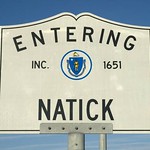
A long time ago, I was solving this puzzle and got stuck at an unguessable (to me) crossing: N. C. WYETH crossing NATICK at the "N"—I knew WYETH but forgot his initials, and NATICK ... is a suburb of Boston that I had no hope of knowing. It was clued as someplace the Boston Marathon runs through (???). Anyway, NATICK— the more obscure name in that crossing—became shorthand for an unguessable cross, esp. where the cross involves two proper nouns, neither of which is exceedingly well known. NATICK took hold as crossword slang, and the term can now be both noun ("I had a NATICK in the SW corner...") or verb ("I got NATICKED by 50A / 34D!")