Showing posts with label Philip Koski. Show all posts

Ka ___ (southernmost point in the U.S.) / WED 2-12-25 / Satirist Michael / Either of two for Mozart's Queen of the Night / Success against all odds / Lizard mascot with a Cockney accent / Where a wedge may be used / Inexpensive beer, informally

Wednesday, February 12, 2025

Constructor: Philip Koski

Relative difficulty: Medium (oversized 15x16)


THEME: BEHIND A / PAYWALL (60A: With 63-Across, where some journalism is located ... or how to interpret the ends of 20-, 30- and 44-Across) — words meaning "PAY" (WAGE, SALARY) form "WALL"s behind which (i.e. on the right side of which) one can find a word meaning "an item of published journalism," in three theme answers:

Theme answers:
  • DEFINITE ARTICLE (20A: The) (ARTICLE appears on the other side of WAGE (7D: ___ gap))
  • SPEAKS ONE'S PIECE (30A: Talks frankly) (PIECE appears on the other side of SALARY (33D: ___ cap))
  • CINDERELLA STORY (44A: Success against all odds) (STORY also appears on the other side of SALARY)
Word of the Day: Queen of the Night aria (48A: Either of two for Mozart's Queen of the Night) —

"Der Hölle Rache kocht in meinem Herzen" ("Hell's vengeance boils in my heart"), commonly abbreviated "Der Hölle Rache", is an aria sung by the Queen of the Night, a coloratura soprano part, in the second act of Mozart's opera The Magic Flute (Die Zauberflöte). It depicts a fit of vengeful rage in which the Queen of the Night places a knife into the hand of her daughter Pamina and exhorts her to assassinate Sarastro, the Queen's rival, else she will disown and curse Pamina.

Memorable with its upper register staccatos, the fast-paced and menacingly grandiose "Der Hölle Rache" is one of the most famous of all opera arias. This rage aria is often referred to as the Queen of the Night aria, although the Queen sings another distinguished aria earlier in the opera, "O zittre nicht, mein lieber Sohn".

• • •

The basic concept is a weird one and I kind of like it. The grid looked very unpromising, with just two shaded Down answers and a top half that's just loaded with very short fill (all 3-4-5s up top). And progression through the grid didn't help me understand the theme at all. I could see WAGE and SALARY—those seemed related (in meaning as well as cluing ([___ gap] + [___ cap]), but what the hell they were doing vis-a-vis anything else in the grid was beyond me. Which means the revealer got to do its damn job, for once—it actually came as a surprise, and helped make sense out of nonsense (or seeming nonsense). The theme answers themselves aren't terribly exciting—love CINDERELLA STORY, but DEFINITE ARTICLE doesn't exactly send shivers up your spine, and man do I have an aversion to all longer answers with "ONE'S" in them (post-traumatic response to seeing A LOT ON ONE'S PLATE multiple times back in the '00s). Plus, I always want ONE'S to be YOUR. ONE'S just sounds affected. But anyway, the answers are all solid, and the revealer truly revealed, and got a LEGIT "aha" (or something like it) out of me, so thematically, we're good today. A nice modern concept (articles BEHIND A PAYWALL) illustrated in a cute graphic wordplay style by the grid.

[2D: "___ to Know" (1999 Marc Anthony hit)]

The one downside of this theme, though, was that it's executed in such a way that a lot (lot lot lot) of pressure is put on the center of the grid, and man can you feel it (in the form of creaky, wince-inducing fill). Literally all of my post-solve "ick" ink is concentrated in the middle of the grid. That is an extremely load-bearing part of the grid, as the theme gets incredibly dense through there—that SALARY "wall" has to hold back not one but two articles (PIECE and STORY). Usually, you spread out your themers so they have some space, some air between them, which allows you to not have to drive so many crosses through more than one themer, which in turn allows for cleaner fill overall. But here, those second and third themers are absolutely hugging each other, or may as well be, as ten (10!) crosses (including the SALARY wall) have to run through *both* of them. No wonder, then, that rows 5 through 11 are just thick with weakish fill, from partial nonsense like TRALA crossing partial nonsense like INA (which gives us a much-unwanted three "IN"s in this grid, all pretty close together (see also DID IN, CONFIDES IN). Then there's RAH next to LLC, then LAE (!?!?!?!?) (!?!?!!?!??!) (46D: Ka ___ (southernmost point in the U.S.)), which crosses the super redundant and awkward OPERA ARIA, and at the bottom of it all (fittingly), SEEPY, oof. [Flowing slowly] should be SEEPING and only SEEPING. My patience for the fill in this puzzle was flowing slowly away at this point, so it's a good thing that the revealer came along at the end and saved the day, turning this puzzle from something of a slog into something of a delight.


Other things:
  • 35D: Wee (EENY) — I hate when the puzzle pretends that people use "EENY" as a standalone word. They use TINY. They do not use EENY except maybe as the first word in a choosing rhyme (EENY-meeny-miney-moe, if I'm spelling that correctly, which I'm probably not), or as the first part of the sing-songy childish phrase "EENY-weenie," which is probably actually gonna be "teeny-weeny" or "eensy-weensy." It's a cloying awful mess, this array of wordlike entities related to smallness. 
  • 11D: Lizard mascot with a Cockney accent (GEICO GECKO) — I guess this is supposed to be marquee fill, but I'm not a fan. Reads like product placement. Also, I'm just ****ing tired of that damn gecko. Why isn't he bygone yet? Speaking of ads, I did not watch the Super Bowl, because I don't care, but I did watch the Super Bowl Halftime show (several times now), which was amazing, and featured, among other people, crossword stalwart SZA! (you can watch it here—YouTube won't let me embed it in my blog)
  • 3D: Tells private things (CONFIDES IN) — I think this alongside "ANY IDEAS?" (4D: "How will we ever get out of this mess?") was the non-thematic highlight of the day, but it also made getting started slightly difficult, in that I had a hard time parsing both answers, and thus a harder-than-usual time (for a Wednesday) whooshing out of that NW corner into the heart of the grid.
  • 65A: Exhaustion from work (BURNOUT) / 66A: Without much hope (BLEAKLY) — good answers, but together on one line, they're a lot to take. BURNOUT BLEAKLY is a little too "capitalist dystopia" for me, pre-coffee. "Exhaustion from work!? Without much hope!?" Shut up, puzzle. You're supposed to be *not* bumming me out.
  • 49A: "Take THAT" ("BOOM!") — had the "M" and wrote in "WHAM!" Then changed the "W" to "B" and wrote in "BLAM!" Sigh.
  • 22D: Where a wedge may be used (TRAP) — had no idea what was going on here, even after I got the whole answer. Could not imagine what the TRAP was. Mouse TRAP? The TRAP in the plumbing below your sink? Was the "wedge" a shoe heel? Some kind of shim? This is what happens when you don't play golf. The TRAP is a sand trap (a golf course hazard), and the "wedge" is a type of club. Other sports stuff it's possible you didn't understand includes BELL LAP (the final lap of a race) (28D: When to wave the white flag) and screen PASS (a short forward pass to a receiver protected by a screen of blockers) (36A: Screen play?)
  • 63D: Inexpensive beer, informally (PBR) — Pabst! Blue! Ribbon!
  • 47D: Sign of a hound's happiness (TAILWAG) — this was another non-thematic part of the grid that I really liked. Nice to be welcomed (at the end of the solve) with a tail-wagging pupper. Who's a good boy!? This answer is. Yes he is. Yyyyes he is.
See you next time.

Signed, Rex Parker, King of CrossWorld

[Follow Rex Parker on BlueSky and Facebook]

Read more...

English site of W.W. II code-breaking / THU 6-8-23 / Plants from which rope are made / Sea urchin in Japanese cuisine / Device patented in 1970 as an "X-Y position indicator for a display system

Thursday, June 8, 2023

Constructor: Philip Koski

Relative difficulty: Medium

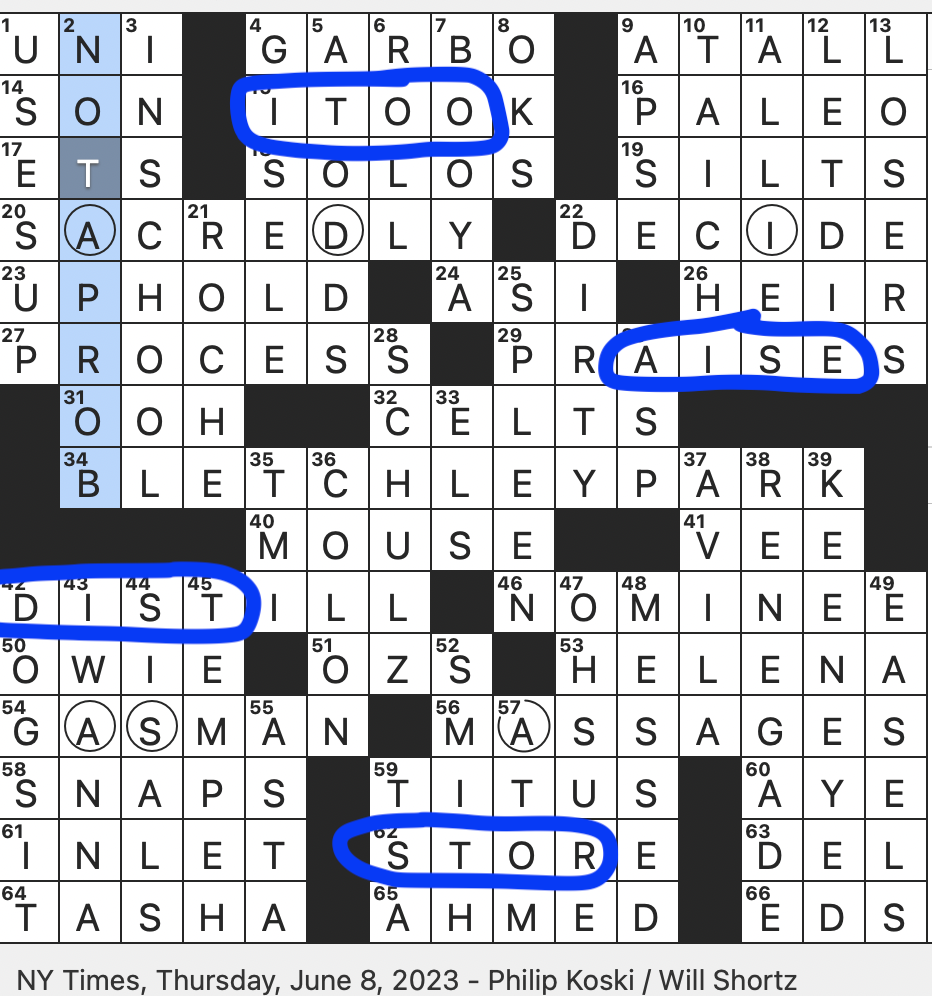
[Pretend those blue-circled answers are "shaded"]

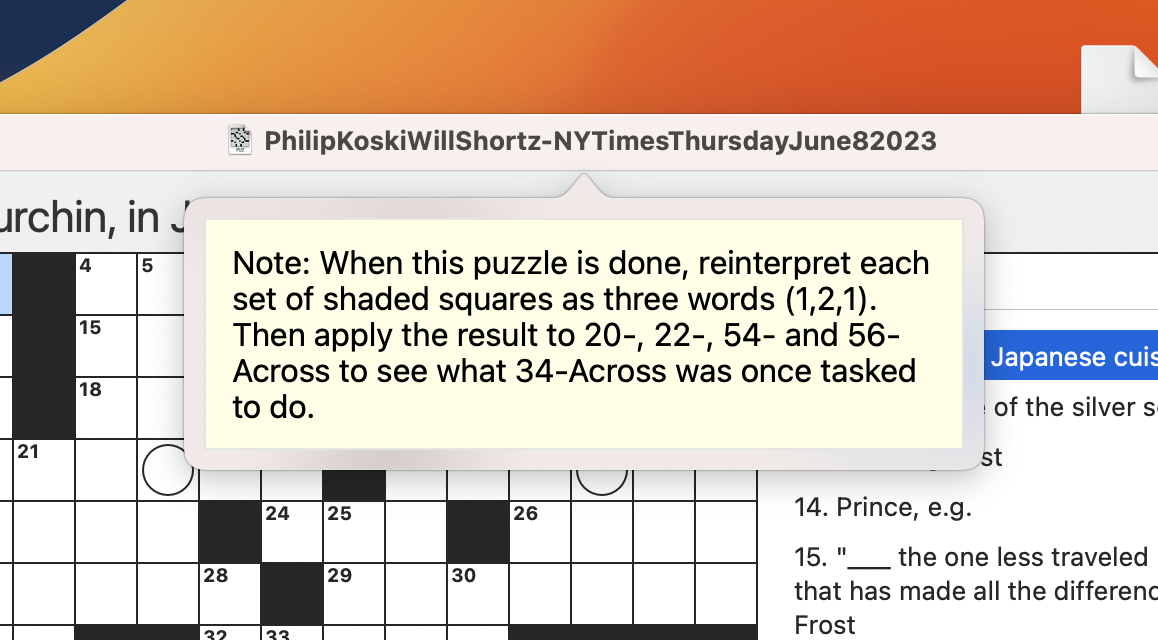
THEME: BLETCHLEY PARK (34A: English site of W.W. II code-breaking) — there are ... instructions:


So, where the 6 circled letters are concerned, change "I" TO "O," "A" to "E," "D" to "T," and "S" TO "R" and the circle-containing answers end up spelling out "what BLETCHLEY PARK was once tasked to do," i.e. SECRETLY / DECODE / GERMAN / MESSAGES:

To repeat: apply this code to the answers with circles:
  • ITOOK => "I" TO "O"
  • PRAISES => "A" IS "E"
  • DISTILL => "D" IS "T"
  • STORE => "S" TO "R"
... and SACREDLY DECIDE GASMAN MASSAGES becomes SECRETLY DECODE GERMAN MESSAGES
Word of the Day: TASHA Cobbs Leonard (64A: Gospel singer ___ Cobbs Leonard) —

Natasha Tameika Cobbs Leonard (born July 7, 1981) is an American gospel musician and songwriter. She released the extended play Grace in 2013 with the hit lead single "Break Every Chain". The EP reached No. 61 on the Billboard charts. 

At the 56th Annual Grammy Awards Cobbs won the Grammy for Best Gospel/Contemporary Christian Music Performance. She has also won 15 Stellar Awards, 3 Billboard Music Awards, and 9 Dove Awards. (wikipedia)

• • •
Forget the fact that my software didn't show the shaded squares, or that I've never heard of BLETCHLEY PARK and so filling in most of BLETCHLEY was just hilarious guesswork. Neither of these things is relevant. It was clear that the "shaded" squares were something I needed to pay attention to only after solving, and as for BLETCHLEY, well, I frequently don't know things, so who cares? These are not the reasons this puzzle is a giant drag. This puzzle is a giant drag for two other reasons: 1. the actual solve—you know, the part where you put words in the grid ... the solve ... the thing you do puzzles for ... the actual doing of puzzles ... that part, i.e. the whole part that didn't involve decoding, was like solving a very weak themeless puzzle. The fill was boring, often poor, and the only marquee answer you get is BLETCHLEY PARK. Whatever interest this puzzle has lies entirely *outside* the filling in of the grid. So doing the actual work was joyless. But (2.) you don't know the meaning of the word "joyless" until you do the decoding, which is the puzzle's *entire* raison d'être, and which is about as exciting and revelatory as solving a child's placemat puzzle (By the way, what is my frame of reference here? I remember being a kid in the '70s and some restaurants would have special placemats for kids with activities and stuff, but I don't know *which* restaurants. Was it IHOP?). Every time I have to do one of these post-solve decoder puzzles (yes, this is an actual genre), I think of how disappointed, and then angry, Ralphie is in A Christmas Story when he finally gets his "Little Orphan Annie" secret decoder ring and the big payoff—the message he's finally able to decode at the end of the radio show—is just an ad: "BE SURE TO DRINK YOUR OVALTINE" ("Ovaltine? A crummy commercial?! Son of a bitch!"). Today's puzzle is a paradigmatic Ovaltine puzzle—no fun to solve, and with a payoff that ... doesn't.


I mean, I wrote in "I TOOK" and thought "wow, that is an awful partial, one of the worst I've ever seen, inexcusable in a grid that's this uncomplicated and easy to fill." And then (of course) I find out that it's one of the "shaded squares" that I can't see. But even if the shaded squares *had* been there, my opinion would've been no different. I'd just have realized sooner that the "theme" is making the actual *solve* bad. Too much is sacrificed for too little. There's no Thursday tricksiness here—not in the actual solving experience there's not. And there's no standout or entertaining answers along the way except maybe "NOT A PROB" (that one has some life) (2D: "'S all good"). No actual thematic content besides the central answer. Instead, you've got convoluted instructions and an anticlimactic revealer—the least complicated "coded message" of all time. No OOHs here today. Not one. The puzzle USES UP most of my goodwill in making me read those long instructions, and then exhausts it with the final message. Did anything else happen in this puzzle? I don't remember. I struggled a bit, mostly around BLETCHLEY. I thought DECIDE *was* DECODE at first (22A: End analysis paralysis), so that was awkward—realizing that I had already unintentionally cracked part of the code with my first (seemingly reasonable) guess. Never heard of TASHA Cobbs Leonard, but I never listen to contemporary Gospel, so that's not surprising. Crosses were fair. I had ATAD as my first answer at 57D: Tiny bit (ATOM). Just a bunch of normal dumb stuff. Nothing memorable or remarkable. RENEGADE and KEEN-EYED are a nice-looking pair. The solve wasn't miserable. It was just blah. And the decoded message didn't offset the blah. That's all.


Bullets:
  • 1A: Sea urchin, in Japanese cuisine (UNI) — totally forgot this. Eel is UNAGI, so for urchin you just ... take the "ag" out of UNAGI and ... there you go, UNI (this is a terrible mnemonic and I'm gonna forget UNI again the next time I see it, for sure).
  • 40A: Device patented in 1970 as an "X-Y position indicator for a display system (MOUSE)
     — had -OUSE and still no idea; wrote in DOUSE (doesn't "dousing" "indicate" the "position" of water underground? Did I make that up? Oh, dang, that's "dowsing")
  • 18A: Notes to self? (SOLOS) — they're sung by yourself, not to yourself, boo.
  • 26A: One who's bound to succeed? (HEIR) — not really understanding the "bound" part here. You can give up your inheritance, can't you? I really wanted this answer to involve BDSM—anything to liven things up!
  • 41A: What's in the middle of Nashville? (VEE) — the letter "V," right there in the "middle" of the word "Nashville"
  • 61A: Shelter from a storm (INLET) — maybe the hardest answer in the puzzle for me. I just could not get my head around it. Probably by design. Of course I was thinking of a human being needing "shelter," not a boat.
  • 42D: Spend time on a doodle, perhaps (DOGSIT) — "doodle" here is a Labradoodle (a popular crossbreed of two breeds, I forget which* ... dachshund and whippet?)
  • 49D: Things that Jackson Pollock famously eschewed (EASELS) — this took me a bit. Really wanted the answer to be PANTS ... again, anything to liven things up!
Hoping for a livelier tomorrow. See you then.

Signed, Rex Parker, King of CrossWorld 

*I do not forget which

[Follow Rex Parker on Twitter and Facebook]

Read more...

Soprano who ends up trapped in a vault / WED 12-8-21 / Italian alpine cheese / Food industry lobby in brief / Dogs that were once samurai companions / Percussion instrument that's also the name of a popular ringtone / Mid-19th-century Russian ruler described as autocracy personified / Hookup that may get kinky

Wednesday, December 8, 2021

Constructor: Philip Koski

Relative difficulty: Easy-Medium


THEME: "IT'S A / WRAP!" (68A: With 66-Across, director's cry ... or hint to 20-, 37- and 58-Across) — letters in "IT'S A" (!?!?!), in that order, are "wrapped" around the theme answers; that is, the letter string "ITSA" starts at the end of each answer and then "wraps" around to the front:

Theme answers:
  • A BATTLE OF WITS (20A: What intellectual rivals engage in)
  • SARGENT PORTRAIT (37A: "Theodore Roosevelt" or "Robert Louis Stevenson"
  • TSAR NICHOLAS I (58A: Mid-19th-century Russian ruler described as "autocracy personified")
Word of the Day: AMOCO (44A: Classic gas brand) —

Amoco is a brand of petrol stations operating in the eastern United States, and owned by British company BP since 1998. The "Amoco Corporation" (/æməkoʊ/, originally "Standard Oil Company of Indiana" until 1985) was an American chemical and oil company that was founded in 1889, around a refinery located in Whiting, Indiana, United States. Part of the Standard Oil Trust, it focused on gasoline for the new automobile market. In 1911, during the breakup of the trust, it became an independent corporation. Incorporated in Indiana, it was headquartered in Chicago. Amoco merged operations with BP in 1998.

Although the Amoco Corporation merged in 1998, the Amoco name was resurrected in 2017 as a brand that service station owners could choose to use when they purchase supplies from BP in selected areas of the United States.

In 1925, Standard Oil of Indiana absorbed the "American Oil Company",[1]founded in Baltimore in 1910, and incorporated in 1922, by Louis Blausteinand his son Jacob. The combined corporation operated or licensed gas stations under both the Standard name and the American or Amoco name (the latter from American oil company) and its logo using these names became a red, white and blue oval with a torch in the center. By the mid-twentieth century it was ranked the largest oil company in the United States. In 1985, it changed its corporate name to Amoco.[3] Amoco merged with British Petroleum in December 1998 to form BP Amoco, renamed BP in 2001.

• • •

Oof, this puzzle. What is even happening? Saw the split AITS in the first themer and thought "so ... it's about islands? River islands? Islands in the stream?" But no. It's a, it's a, it's a ... IT'S A / WRAP :(  I grasp the concept, I do, and yet ... I don't get it. You're supposed to notice things that no solver is going to care about. Like the fact that IT'S A always appears in that exact letter order. All I saw was an ITSA jumble where some letters appeared on one end and some on the other. Only in writing the theme description did I notice the exactness of the "wrap" thing, but here's the thing: it's not like that discovery made me think "wow!" It made me think "huh ... why?" Yes, the "IT'SA" string advances one letter place with each subsequent theme answer, Who Cares? Noticing these details made me even sadder than I was before I noticed them because it meant that there was such a level of intentionality to the way the theme was built, and yet still the results were still incredibly dull and disappointing. I can't imagine wanting to do anything with the letters in "IT'S A" ... it's a [wink] mystery why anyone would think, "you know what would be fun ... something with the letters in 'IT'S A'." Discovering that those letters "wrapped" *in order* (as opposed to in some kind of jumble) didn't increase my appreciation of the puzzle; it couldn't go back and take all the wincing out of my solve. It did explain why we got *this* (weak) answer set—possible theme answers are a *lot* more limited when your "ITSA" has to be in order, as opposed to just a jumble. But do I now love a random Tsar with a Roman numeral at the end of his name? Do I love that as fill? I do not. Do I love that one of the "A"s (in A BATTLE OF WITS) is not embedded in a larger word but is instead a free-standing word, a gratuitous addition to an answer that under normal circumstances would never feature the indefinite article? I do not. Do I like SARGENT PORTRAIT as a standalone answer? Not really. It's a phrase. And he certainly did paint portraits. But it's not good on its own, the same way DEGAS BALLERINA or TURNER LANDSCAPE would not be good. I say this as someone who loves Sargent and who once stood mesmerized for the better part of an hour one afternoon in front of this astonishing painting:

[Lady Agnew of Lochnaw]

Up close it's breathtaking. The patterns, the textures ... her incredible stare. Peak museum experience, truly (this was in Edinburgh sometime in the mid-'90s, I think). Anyway: Love the painter, love the portrait, don't particularly love SARGENT PORTRAIT as an answer. And the revealer is the thing I resent the most, I think, because it's positioned so awkwardly... but that awkwardness is intentional? Because the answer itself is supposed to "wrap" around the grid (even though it's actually just split in half and doesn't "wrap" in the same mid-word way that ITSA does in the themers). I don't read the Across clues in order, ever, so all I saw was a butchered, awfully laid-out revealer. And again, I keep coming back to the idea that the core of the theme idea here is ... ITSA ... ITSA not-a thing-a. It's a horrible partial in any other grid. If you want to see what I mean by "horrible partial," then just lift your eyes literally one answer up from "IT'SA" and look at ANET (seriously, How Are These Unsightly Answers *Abutting*??). 


The fill overall tends toward the stale (AMOCO ATOI AIDA SEPT AWS SAAB IDA OER NERFS plural (?) ARTOO GAL AROD NRA EDU ... then there's the attempt at clever repeated cluing that just results in misleading / inaccurate cluing, where [Long time] is the correct clue for EON, but then the "no, not necessarily" clue for ERA. When the clue is [Long time], E-- should not be a kealoa*. That is, you should not feel as if you are choosing between two equally valid answers. EON is valid for that clue, ERA really isn't. EONs are long by definition. The idea that an ERA is long is totally arbitrary. We refer to coach / manager stints in sports as ERAs but some of them don't last long at all. A stretch of time is called an ERA because of a certain quality of that time, not the length of that time. So with this repeated cluing, the puzzle once again *intentionally* gives us awkwardness because it thinks it's a feature, not a bug. I don't understand the design mindset here. This is such a hard come-down after yesterday's delightful romp. 


It was easy, though, so at least I didn't have frustration stirred into the mix. I got stymied at STORIED (28A: Like the Tower of Babel, in two ways) and (for whatever reason) TRIBE; I wrote in REST (as in musical notation) before RUST at 54A: Sign of inactivity; and I misspelled AMACO thusly, which made the DOOM cross slightly challenging, but otherwise, no real challenges here. Just a train wreck of a theme. It's not enough to have a theme concept; you really have to think about whether that concept is going to provide any solving pleasure. Otherwise you're just pleasing yourself. See you tomorrow.

Signed, Rex Parker, King of CrossWorld 

P.S. [Hookup that may get kinky?] is a good clue for HOSE. That was the high point of the puzzle for me—a sexy HOSE.

[Follow Rex Parker on Twitter and Facebook]

Read more...

  © Free Blogger Templates Columnus by Ourblogtemplates.com 2008

Back to TOP