THEME: "CONSIDER THE ODDS" (40A: Think before placing a bet ... or what solvers must do to fully appreciate each starred clue) — the odd squares in six answers (which are shaded in the grid) spell out words that are also answers:
Theme answers:
GREEN PEAS (18A: *Mendel studied them) (odd letters spellGENES)
ARCHERS (61A: *Ones with good aim) (odd letters spell ACES)
SITUATION (63A: *Mess that might be sticky) (odd letters spell STAIN)
Word of the Day: YUTZ (4D: Fool, from the Yiddish) —
noun
Slang.
a stupid, unthinking, or socially inept person: // First recorded in 1980–85; of uncertain origin; perhaps an alteration of putz ( def );perhaps from American Yiddish yutz “penis, fool” // [Example sentence]: “I mean, Ted Cruz, think about what a yutz this guy is! I don’t care what your political view is: If a guy said that my wife was ugly and my father killed Kennedy, there is no way in the world you could have me come out and say, ‘I’ll defend you.’
These themers seem like good finds, but it also feels like the themers were "found" by some bit of simple code that someone wrote—one that searches a giant database of answers for words or phrases where the odd numbered letters, taken together, *also* form a word or phrase in that database. From those results, you check to see which pairs can be clued similarly, and voila. Maybe I'm wrong and the constructors just "found" these answers through trial / error / prolonged cogitation, but that sounds ... exhausting. Still, human beings have to conceive the concept, and the concept is clever. Some of the pairs do seem remarkably related—that GREEN PEAS / GENES one, for instance. Right on the money. FRAZZLE / FAZE are a solid pair as well. The rest are fine, with "book designer" pair involving perhaps the biggest stretch when it comes to cluing—I don't think of FOOTNOTEs as the purview of the book "designer," but I suppose there are certain layout and style considerations where FOOTNOTEs are concerned. Still, you could say that about literally any aspect of the book. Whatever, both answers are from Bookville, it's fine. The theme was architecturally interesting, but whatever it gained from the double-answer aspect, it lost (in terms of entertainment value and challenge) by being overly easy. You've got two shots at every clue, two answers going at the same time, and so twice the pattern-recognition power that you'd have with an ordinary clue. I certainly wrote in GENES before I remembered GREEN PEAS—so GENES ended up being a big help toward getting the longer answer. Same with FONT / FOOTNOTE and ALOT / ALL SORTS. This took a lot of the bite out of the puzzle. I wasn't that thrilled with the revealer either, which feels a little weak as a phrase. You play the odds, you weigh the odds ... somehow CONSIDER THE ODDS just doesn't have the standalone pop and oomph that I was hoping for (I got THE ODDS and then had to wait for help from the crosses to get the rather limp CONSIDER.
Also, the revealer was kind of superfluous from a solving standpoint because, I mean, how could I *not* CONSIDER THE ODDS? You highlighted every single one of them for me. The puzzle forces your attention to those squares rather than letting you find them yourself. I can't believe I'm saying this, but this is the kind of puzzle that might actually benefit from one of those post-solve animation dealies the NYTXW has increasingly used as visual glitz in recent years. It would have been nice to have the "odd letters" aspect of this grid appear as a kind of revelation. I guess I did get a kind of "aha," but it was muted, and very early. After the first themer, filling the others in was kind of painting-by-numbers. I was curious to see what the pairs would be, but with the big puzzle twist in my rearview, there just wasn't much aha left. More, "oh, I see." "Did you see!?" Yes, I SAW (56D: "You don't have to tell me").
On the plus side, the grid on the whole seems pretty polished (except that SE corner—what a mess of Es Ts and Ss). Lots of snazzy longer Downs. INNOVATE doesn't do much for me, but the others are actively good, including LAERTES, and particularly RADON TESTS (33D: Parts of many home inspections) and CINEASTE—a word, and magazine, that I love (8D: Film buff). I love it from afar, in that I would never use it in a sentence myself, but I like the way it looks, and I like that it exists. I also like having a few honest-to-god old-fashioned dead-tree magazine subscriptions, and CINEASTE is probably the one I most look forward to. That and the other movie magazine I get, Sight + Sound. I enjoy my New Yorker, but as you probably know, they pile up faster than I can read them. And the Guardian Weekly, oof, good reporting and writing, but I can't say I look forward to it. Every issue has some atrocity front and center, right on the cover. I mostly just hand that magazine to my wife immediately, and then she'll direct my attention later to whatever movie / book / culture article she thinks might be interesting to me. Honestly, I mainly get the Guardian for the cryptic crossword in the back (highly recommended if you are an American training to be a better cryptic solver and want to be humiliated by your insufficient skills (and non-Britishness) on a regular basis)
Bullets:
1A: Flower in a children's rhyme (POSY) — first thought was IRIS, but that's only because my best friends have a child named IRIS. As soon as my brain went into "children's rhyme" mode, "pocket full of POSY" came to me straight away.
44A: Amazon Handmade competitor (ETSY) — wow, I didn't even know Amazon Handmade existed, so I'd say ETSY is (improbably) winning the branding wars. Amazon Handmade should try a shorter, more crossword friendly name. Worked with ECHO and (esp.) ALEXA. I mean, ask Apple about its choice to lean into crossword-friendly names. Or better yet, ask SIRI. All the free advertising anyone could dream of ... (IMAC, IPAD, IPOD, etc. etc. etc.)
40D: Lunchroom, casually (CAF) — now I know what this emoji 😒 is supposed to signify—it's my face when someone tries to convince me that people call the cafeteria the "CAF."
54D: Longtime Saints QB whose name has a windy homophone (BREES) — weird to add the homophone bit. Drew BREES is a future Hall-of-Famer. I can see adding the "windy homophone" helper on a M or T, but by W things should toughen up. I mean, you didn't use a "sounds like a Canadian gas brand" helper on Sylvan ESSO (12D: Sylvan ___ (electropop duo)), and that band is way Way more obscure than Drew BREES.
That's all for the puzzle today. Time to move on to our ongoing end-of-year feature, Holiday Pet Pics (submissions are now closed, try again next year!)
It's an all-cat extravaganza today. Instead of ending with a partridge in a pear tree, we'll start with kittens in Christmas trees ... again! (it's the most common genre of Holiday Pet Pic). This is Lilly, who has gone to all the trouble of getting into the tree but is now distracted by some piece of fluff on the ground that only a cat could possibly see or be interested in. Careful jumping down, Lilly!
[Thanks, Michelle]
And here's another tree explorer, Remy. "I iz ornament?" For now, Remy, yeah. (Look at his silly hind leg hanging down. Hang in there, buddy!]
[Thanks, Olivia]
Annie, on the other hand, has decided that a small plush fake tree is safer
[Thanks, Kitty]
Barney is making a return appearance. He was on the blog last year. He is now a very elegant 17 years old. After allowing you to take his photo, he is headed to the club to enjoy a cigar and a martini. Send the driver for him around 7pm, would you?
[Thanks, Stacy]
Maizie wants you to know that she is in no way a willing participant in this "Christmas spirit" stuff. She is simply warming her butt on the charging laptop. Any appearance of festiveness is completely coincidental.
[Thanks, Linda]
And finally today we have Orzo and Moose, fighting over the NYT's special holiday Puzzle Mania section. Don't worry, guys, there are more than 50 puzzles, you can share! What? You don't want to solve the puzzles in Puzzle Mania, you just want to sit on it because it's rectangular and on a flat surface? Oh, well, then, fight to the death, I guess
Relative difficulty: Easy or Challenging (depending on your familiarity with the architecture in question)
THEME:THE SPANISH STEPS (67A: Architectural attraction in Rome depicted by this puzzle's grid?) — a famous Roman staircase leading up to the TRINITÀ DEI MONTI church, and represented here by a staircase-shaped set of circled squares where the "steps" are made out of "Spanish" numbers (UNO DOS TRES CUATRO)
The Spanish Steps (Italian: Scalinata di Trinità dei Monti) in Rome, Italy, climb a steep slope between Piazza di Spagna at the base and Piazza Trinità dei Monti, dominated by the Trinità dei Monti church, at the top.
The monumental stairway of 135 steps is linked with the Trinità dei Monti church, under the patronage of the Bourbon kings of France, at the top of the steps and the Spanish Embassy to the Holy See in the Palazzo Monaldeschi at the bottom of the steps. The stairway was designed by the architects Francesco de Sanctis and Alessandro Specchi. (wikipedia)
• • •
I've never been to Rome, never even set foot in Italy, never heard of the TRINITÀ DEI MONTI, and I only know THE SPANISH STEPS exist from watching a lot (a lot) of Italian "giallo" films of the '60s and '70s:
[La Ragazza Che Sapeva Troppo (1963), d. Mario Bava]
... though I watched Roman Holiday this summer, so I must've seen them then, too:
[Roman Holiday (1953), d. Wyler]
They're also in Anthony Minghella's 1999 adaptation of The Talented Mr. Ripley:
[The Talented Mr. Ripley (1999), d. Minghella]
So they're iconic, and I've seen them (in movies) a number of times, but still, I couldn't retrieve their name (had STEPS and could think only of THIRTY-NINE STEPS — a perfect fit (15!) ... but a Hitchcock movie (1935), not an actual staircase). And I certainly didn't know the name of the church (needed every cross (!) for that one). So I can't say I enjoyed the puzzle, because I just didn't know the reference (not really), so there was no spark of recognition. That's my problem, admittedly. The staircase is certainly famous enough, and if you're familiar with it by name, then I can see admiring this. The one thing I don't really get is the staircase itself. I get that you have built the "STEPS" out of "SPANISH" numbers, but why numbers? And why four? Obviously there are more than four steps. The "staircase" depicted in the grid has eight steps, but as you can see from the pictures above, the actual SPANISH STEPS far outnumber that (135 steps!). So the visual here feels like something kind of tacked on because the constructor(s) made the serendipitous discovery that both TRINITÀ DEI MONTI and THE SPANISH STEPS were a perfect, grid-spanning 15 letters long ... and then couldn't really think of what to do from there. So we get a "staircase" with an arbitrary number of steps and an arbitrary set of Spanish words. To be fair, it's kind of a cute solution to the problem of depicting "Spanish" "steps" — maybe a simple visual pun is enough — but the connection to the actual steps feels pretty tenuous.
["Uno, dos, tres, cuatro!"]
The fill on this one starts out pretty awful (ÉTÉ ENIAC ORANG, all at once, yeesh), but then you get the lovely LACUNA (just me? I love that word) (22A: Unfilled space) and the handsome IGNOBLE and the PRIMROSE PITMASTER who TRIED HARD, and the short stuff gets less ugly, so overall the grid actually ended up being pretty enjoyable to work through. Winced hard at TRADESIES though (43A: Cutesy term for a swap) ... didn't we just have one of these cutesy -SIES expressions? SAMESIES, maybe? TWINSIES? I forget. Anyway, whatever it was, it was more familiar / in-the-language than TRADESIES (?) feels. Also winced at DISTROS, but that's just because I have no idea what that is (42D: Linux software packages, informally). It may surprise you to find that I've spent very little time thinking about [squints at grid] "Linux software packages," let alone thinking about them "informally," so pfft, shrug, if you insist. But again, otherwise, once you get out of that NW corner, this grid seems just fine.
More points of interest:
13A: Lawless princess (XENA) — while XENA may have occasionally (frequently?) stepped outside the bounds of the law, the "Lawless" here represents the actress's name—Lucy Lawless
24A: Half of a Dashiell Hammett detective couple (NORA) — The other half is Nick. The couple is featured in the novel The Thin Man, which was adapted into the classic 1987 movie, Ernest Goes to Camp. Nick & NORA also lend their names to a style of cocktail glass. We have two chilling in our freezer at all times :)
29D: Bright spots? (ATRIA) — had the "A," wrote in AURAS, got briefly (and, it turns out, pointlessly) mad at the whole AURAS v. AURAE problem.
64D: Sunrise direction, in San Salvador (ESTE) — hard to get excited about a piece of crosswordese like ESTE, but I did like that the puzzle managed to work both "Salvador" and "Dali" into the clues (9A: Like the watches in Dali's "The Persistence of Memory"). The choice of "San Salvador" felt like a wink at the earlier Dali clue, which probably wasn't intentional, but it's art, man, you see what you see. And Dali was Spanish too! And he painted staircases! Who's seeing things now?!
THEME: "For Your Amusement" — amusement park attractions that are depicted visually in the grid (in circled-square formations)
Theme answers:
DROP TOWER (4D: Amusement park attraction depicted to the right of this answer)
BUMPER CARS (25A: Amusement park attraction depicted above and below this answer)
ROLLER COASTER (65A: Amusement park attraction depicted weaving through this answer)
WATER SLIDE (111A: Amusement park attraction depicted above this answer)
WHAC-A-MOLE (79D: Amusement park attraction depicted in and around this answer)
Word of the Day: Louis SACHAR (67D: Louis who wrote "Holes") —
Louis Sachar (/ˈsækər/SAK-ər; born March 20, 1954) is an American young-adult mystery-comedy author. He is best known for the Wayside School series and the novel Holes.
Holes won the 1998 U.S. National Book Award for Young People's Literature and the 1999 Newbery Medal for the year's "most distinguished contribution to American literature for children". In 2013, it was ranked sixth among all children's novels in a survey published by School Library Journal. [...] Holes is a 1998 young adultnovel written by Louis Sachar and first published by Farrar, Straus and Giroux. The book centers on Stanley Yelnats, who is sent to Camp Green Lake, a correctional boot camp in a desert in Texas, after being falsely accused of theft. The plot explores the history of the area and how the actions of several characters in the past have affected Stanley's life in the present. These interconnecting stories touch on themes such as labor, boyhood and masculinity, friendship, meaning of names, illiteracy, and elements of fairy tales.
The book was both a critical and commercial success. Much of the praise for the book has centered around its complex plot, interesting characters, and representation of people of color and incarcerated youth. [...] Holes was adapted by Walt Disney Pictures as a feature film of the same name released in 2003. The film received generally positive reviews from critics, was commercially successful, and was released in conjunction with the book companion Stanley Yelnats' Survival Guide to Camp Green Lake. (wikipedia)
• • •
I'm normally a fan of these constructors, but this one fell flat for me. The visuals just aren't interesting or evocative enough. Tepid, if visuals can be called tepid, which they can, because I'm calling them that. The most creative of the "amusement park attraction" visual representations is the WHAC-A-MOLE, with those various "MOLE" parts peeking out from their (imagined) holes there at the bottom of the grid. That's cute. But the others? I dunno. The "slide" is just ... a diagonal? Five letters on a diagonal. And DROP TOWER is just five letters divided by one black square? I get that the "ER" is supposed to be "dropping" away, so ... I see it, but it just doesn't make much of a visual impression. Aside from weakness, one of the visuals is completely (I would argue, fatally) unlike the others, in that it completely fails to follow the representational logic of the set. See, for DROP TOWER, you get the "drop" represented by the circled-square arrangement of the letters in "TOWER"; for BUMPER CARS, you get the "bumper"ness of the cars represented by the circled-square arrangement of the letters in "CAR" (three times). One word in the straightforward answer ("DROP"; "BUMPER") forms the basis for the circled-square arrangement of the other word(s) in the straightforward answer ... except. Except for ROLLER COASTER. If ROLLER COASTER were done right (or done according the theme's own logic), then only the word "COASTER" would be "rolling," just like only "TOWER" is "dropping" and only "WATER" is "sliding" and only "MOLE" is "whac-a"-ble. It's such a glaring issue that ... yeah, I don't get it. I don't get why the inconsistency didn't bother anyone. Maybe it did and they just decided "who cares?" There's just not enough sizzle in this thing to make the inconsistent execution worth it. A more eye-popping or stunning or otherwise impressive themer set might've made the ROLLER COASTER thing overlookable. But as I said up front, the visuals are just too tepid, and so the inconsistency of ROLLER COASTER seems like more of a liability.
While there were some parts of this grid I didn't enjoy at all (ORRERY into RESPAWN into SACHAR (?), above all), for the most part the fill is solid and varied and even amusing. CHEST HAIR over HATERADE is easily the highlight of the puzzle for me (85A: Prominent feature of Tom Selleck or David Hasselhoff / 89A: Sour grapes drink?). Just imagining a bunch of dudes in the early-80s watching "Magnum P.I." and trying to convince themselves Tom Selleck isn't that sexy. Maybe mocking his short shorts, or his prodigious 'stache, or the Farrah-style pin-up posters on their sisters' bedroom walls ... just drinking the CHEST HAIR HATERADE ...
[for comparison]
You all know the term "HATERADE," right? It's what haters drink. When they're hating. They drink "HATERADE." It's metaphorical. A portmanteau of "hater" and "Gatorade." I feel like the term gained currency some time in the late 20th century ... yes, the OED's earliest evidence for "HATERADE" comes from 1993. Here's their definition: "A notional drink that engenders or embodies feelings of hatred, negativity, or resentment; chiefly as part of an extended metaphor, esp. in to drink…" Ooh, "notional." I like that better than "metaphorical." This is the fourth NYTXW appearance of HATERADE, so maybe you're all familiar with the term already. The clue for it today was diabolical, which is probably what's making it stand out to me (89A: Sour grapes drink?). I was like, "[Sour grapes drink?] ... well ... that's ... wine ... kind of, right? Some kind of ... wine?" No. Bigger problem for me in that section was the answer directly under HATERADE: I had -I-S at 95A: Lapel attachments and of course I wrote in PINS because, I mean, lapel PINS, that's what they are, literally, things attached to lapels, argh. So it took me a while to pull out PINS and put in MICS; PINS ensured that both SEMOLINA and WHAC-A-MOLE were slow in coming together.
[I went downstairs just now, where my wife is solving the puzzle on a clipboard, and the *first* thing she said is "What's going on with ROLLER COASTER?! 'ROLLER' should not be in those circled squares ... "COASTER" should be "rolling" in those squares ... those squares should say COASTER COASTER!" So I feel vindicated, and also "COASTER COASTER" is our new word for "ROLLER COASTER"]
Further notes:
15A: Quick second? (ASST.) — "Quick" = abbrev. indicator, and "second" = (per merriam webster dot com, noun (1) def. 2) "one that assists or supports another, especially the assistant of a duelist or boxer." So "quick second" = "abbreviated assistant" = ASST.
36A: N.Y.C. home of "Christina's World" (MoMA) — extremely famous and oft-parodied Wyeth painting, in case you forgot or somehow didn't know ...
[Andrew, *not* N.C.]
51A: "Her Kind" poet Sexton (ANNE) —
I have gone out, a possessed witch, haunting the black air, braver at night; dreaming evil, I have done my hitch over the plain houses, light by light: lonely thing, twelve-fingered, out of mind. A woman like that is not a woman, quite. I have been her kind.
I have found the warm caves in the woods, filled them with skillets, carvings, shelves, closets, silks, innumerable goods; fixed the suppers for the worms and the elves: whining, rearranging the disaligned. A woman like that is misunderstood. I have been her kind.
I have ridden in your cart, driver, waved my nude arms at villages going by, learning the last bright routes, survivor where your flames still bite my thigh and my ribs crack where your wheels wind. A woman like that is not ashamed to die. I have been her kind.
114A: People who call New Zealand "Aotearoa" (MAORI) — pretty sure everyone calls it that now. "Beginning in the late 20th century, Aotearoa has become widespread in the bilingual naming of national organisations and institutions" (wikipedia). But yeah, it's a MAORI-language term.
117A: Nickname for the Los Angeles Angels (HALOS) — I got this easily, but semi-balked at the spelling, as I want most pluralized "O"-ending words to be spelled -OES. Don't I? HEROES, yes. But then ZEROS. And LASSOS and SOLOS. But definitely POTATOES. Man, English is insane.
5D: Participate in a Lakota smudging ceremony (BURN SAGE) — don't love this. That is, I do love it, or would, if SMUDGE or SMUDGING were the *answer* ... that feels like a coherent thing. BURN SAGE feels like an arbitrary verb phrase, like "paint walls" or "eat food" or whatever. Feels like a clue, not an answer.
10D: A gilded one is seen on King Tut's crown (COBRA) — had the -RA in place, so the word "crown" in the clue triggered an automatic TIARA response.
37D: Jazz pianist Garner (ERROLL) — A one-L ERROL, he's a drinker / A two-L ERROLL, he's a ... plinker?
36D: Fruity Italian wine (MOSCATO) — never had MOSCATO, to my knowledge, but I have had (German, or maybe French) Muscat, which helped here.
97D: Part of an omakase meal (SUSHI) — got this off the "I," but can't remember what "omakase" means ... I must've seen the term in Kamogawa Food Detectives, or heard it in Jiro Dreams of Sushi (2011), but I just ... forgot. Here we go:
The phrase omakase, literally 'I leave it up to you', is most commonly used when dining at Japanese restaurants where the customer leaves it up to the chef to select and serve seasonal specialties. The Japanese antonym for omakase is okonomi (from 好みkonomi, "preference, what one likes"), which means choosing what to order. In American English, the expression is used by patrons at sushirestaurants to leave the selection to the chef, as opposed to ordering à la carte. The chef will present a series of plates, beginning with the lightest fare and proceeding to the heaviest dishes. The phrase is not exclusive to raw fish with rice and can incorporate grilling, simmering and other cooking techniques. (wikipedia)
71D: Consequently (THENCE) — ugh you wouldn't think a word like this could flummox me, esp. with the "TH-" in place, but yeesh. THUSLY? THERETO? Whatever quaint and / or legalistic word was being asked of me, my brain just could not.
OK, that's all. This puzzle wasn't for my amusement, but maybe it was for yours. I hope so. See ya.
THEME: RSVPING (60A: Acknowledging and invitation ... or a hint to the starts of 19-, 32-, 39- and 49-Across) — the letters R, S, V and P precede "-ING" in the first word of each theme answer; so the puzzle itself is RSVPING, in a way; it's "R"ing, then it's "S"ing, then it's "V"ing, then it's "P"ing ... (!)
Theme answers:
RING ANNOUNCER (19A: "And in this corner..." speaker)
SING BACK-UP (32A: Use non-lead pipes?)
VING RHAMES (39A: Actor who plays Luther Stickell in the "Mission: Impossible" franchise)
PING-PONG BALLS (49A: Projectiles tossed into cups of beer, in a drinking game)
Word of the Day: Beer pong (the "drinking game" in the clue for PING-PONG BALLS) —
Beer pong, also known as Beirut, is a drinking game in which players throw a ping pongball across a table with the intent of landing the ball in a cup of beer on the other end. The game typically consists of opposing teams of two or more players per side with 6 or 10 cups set up in a triangle formation on each side. Each team then takes turns attempting to throw ping-pong balls into the opponent's cups. If the team "makes" a cup - that is, the ball lands in it, and stays in it - the contents of the cup are consumed by the other team and the cup is removed from the table. The first team to eliminate all of the opponent's cups is the winner. [...] The game was originally believed to have evolved from the originalbeer pong played with paddleswhich is generally regarded to have had its origins within the fraternities ofDartmouth Collegein the U.S. in the 1950s and 1960s, where it has since become part of the social culture of the campus. The original version resembled an actualping ponggame with a net and one or more cups of beer on each side of the table.Eventually, a version withoutpaddleswas invented and the namesBeer PongandBeirutwere adopted in some areas of the United States sometime in the 1980s.In some places,Beer Pongrefers to the version of the game with paddles, andBeirutto the version without. // Bucknell University's student-run newspaper,The Bucknellian, claimsDelta Upsilonfraternity members at Bucknell created "Throw Pong", a game very similar to beer pong, during the 1970s,and that "Throw Pong" was then brought toLehigh Universityby fraternity brothers who visited Bucknell and this led to the creation of the version of beer pong that is played today. // The origin of the name "Beirut" is disputed. A 2004 op-ed article inThe Daily Princetonian, the student newspaper atPrinceton University, suggested that the name was possibly coined at Bucknell or Lehigh University around the time of theLebanese Civil War.Beirut, the capital ofLebanon, was the scene of much fighting during the war, particularlymortar fire. (wikipedia)
• • •
Easy but not boring, with a revealer that does what it's supposed to do—reveal, in a surprising way. I could see the "-ING" repetition but thought "that is not a theme, what are we even doing here?" And then I hit RSVPING and had a sincere "ohhhhhhhh, OK" moment. It's silly, but it works, and I don't know that I want anything more out of my Tuesday revealer than that. It's R'ing, it's S'ing, it's V'ing, it's P'ing, it's here it's there it's everywhere, ing ing ing, ding ding ding, great. And if the RING and SING answers aren't *that* exciting, the SING and VING answers make up for it. Well, let's start with the VING answer, because it seems like there *aren't* any other VING answers besides this one. I don't know if VING RHAMES was the inspiration for this puzzle, but he's certainly the person you can't make this puzzle without. The necessary ingredient. I assume he's a household name by now—I've known his name for three decades, ever since his Extremely Memorable performance as Marcellus in Pulp Fiction (1994). The plot with him and Bruce Willis is extremely violent (Rhames tries to kill Bruce Willis, but then they both get taken hostage in the basement of a pawn shop ... very bad things happen ...), but what I remember most about his performance in that movie is the back of his neck. The first time you see him, the camera is trained on the back of his very thick neck and bald head for a very long time, as he sits at a table in a bar. Makes him seem very cool and imposing. His neck has a band-aid on it, which apparently inspired a ton of fan theories ("the devil takes your soul from the back of your neck" "he cut himself shaving" etc.).
I rewatched the movie recently, which is to say I sat next to two guys (one right next to me, another one row up) who were both watching the movie on an airplane, and so I kept jumping back and forth between screens, watching the movie without sound. It's amazing how much I didn't need sound. It all came back. Great movie. VING RHAMES is also fantastic in one of the other great crime films of the '90s: Steven Soderbergh's Out of Sight (1998), where he plays George Clooney's longtime partner in crime (the crime being heists, mostly banks). Apparently, he's also in the Mission: Impossible franchise. That, I'm less familiar with. But I didn't need the clue today: I no-looked his name just from letters I already had in place (I tend to work short crosses before I ever even look at longer answers). As I say, not many things start with "VING."
The other themer I enjoyed was SING BACK-UP. It's an original answer *and* it has a wicked trick (32A: Use non-lead pipes?)—one of the only challenging moments of the puzzle. Not the element lead, as the clue implies, but "lead" as in "lead singer," and not "pipes" as in plumbing but "pipes" as a metaphor for one's singing voice. Late-week trickery on a Tuesday. I like it. So, as for the theme—it was too thin ... until it wasn't. Revealer to the rescue. I wonder why they went with PING PONG BALLS and not PING PONG TABLE. Is "BALLS" just an inherently funnier word? I think I just answered my own question. There's something about the BALLS portion of this grid that is both messy and interesting. A pile-up of consonants and odd letter juxtapositions, with RSVP running through NHLMVP (44D: Hart Memorial Trophy recipient, for short) running through THX (48A: Text of appreciation), with the odd "XL" in OXLIP (45D: Yellow primrose) and the odd "-SI" ending on TARSI (48D: Ankle bones), all with the very smooth and original AIR MILES running through it. Like it or not, it's got character, that corner. Does it also have BALLS? Well, literally, yes. You can see that.
If I look at my Mac keyboard ... well, actually, it's a wireless keyboard, not the one on my actual Mac (laptop). I was gonna say, if I look at my keyboard, I see "ALT" printed just above "option," so I can see easily that they're the same key. But the key on my actual laptop just says "option." This is all to say I could've guessed ALT (1A: Option : Mac :: ___ : PC), but I cheated and looked down, just to be sure. Is Voodoo Ranger a known beer!!? (4A: Voodoo Ranger, e.g., for short). I got IPA easily from crosses but remember thinking "what the hell is that?" (as you know, I'm more a cocktail drinker; cocktails, wine, beer, in that order (order of preference, obviously, not order of consumption, that would be ... a lot)). Interesting clue on TL;DR today (3D: "To recap," in an initialism). I first knew the initialism as a dismissive comment made in response to some other commenter's longwindedness (it stands for "too long; didn't read," after all). It was created to ridicule, but has apparently morphed into a more neutral summing-up term. Language is funny.
Bullets:
6D: Soprano Netrebko (ANNA) — kind of a big deal. She is a Russian who made some comments at the start of the Ukraine invasion that got her into trouble. They don't seem terribly controversial, tbh (she condemned the war but thought artists should be allowed to be apolitical and not be forced to speak out against their homeland), but the blowback was harsh. Performances were canceled, etc. Then she opposed the war more clearly and forcefully and was denounced as a traitor by Russia. I am just now discovering that "Netrebko made a cameo appearance as herself in the 2004 film The Princess Diaries 2: Royal Engagement" (wikipedia), so having recently waded into the whole Princess Diaries universe (one week ago today), I may have to check this one out. It still has Julie Andrews, right? OK, good. I own one Netrebko album and while I'm no opera expert, I think she sounds sensational.
51D: Brooklyn squad (NETS) — I hesitated at -ETS, but I'm not sure why. The NETS are in Brooklyn, the METS are in Queens, and the JETS ... I dunno, New Jersey somewhere, I think. Those, Ladies and Gentlemen, are your New York -ETS!
42A: Uber- relative (MEGA) — really should've taken that dash into consideration. I didn't write in LYFT here, but I definitely considered it.
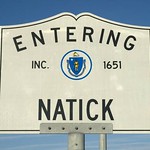
A long time ago, I was solving this puzzle and got stuck at an unguessable (to me) crossing: N. C. WYETH crossing NATICK at the "N"—I knew WYETH but forgot his initials, and NATICK ... is a suburb of Boston that I had no hope of knowing. It was clued as someplace the Boston Marathon runs through (???). Anyway, NATICK— the more obscure name in that crossing—became shorthand for an unguessable cross, esp. where the cross involves two proper nouns, neither of which is exceedingly well known. NATICK took hold as crossword slang, and the term can now be both noun ("I had a NATICK in the SW corner...") or verb ("I got NATICKED by 50A / 34D!")