Constructor: Anne Marie Crinnion and Eric Bornstein
Relative difficulty: Very Easy
THEME: DROP DOWN MENU (46A: Options at the top of a computer window ... as seen three times in this puzzle?) — three familiar answers "drop down" for their last four letters, and those letters spell out different types of "menu" (FILE, EDIT, VIEW) that live at the top of your computer screen, in your operating system or web browser or whatever, see:
Theme answers:
HIGH PROFILE (20A: Attracting much publicity)
SCHOLARLY REVIEW (27A: Commentary on a scientific article)
STORE CREDIT (56A: Alternative to a refund, often)
Word of the Day: OCELOTS (37A: Cats with the unique ability to turn their ankle joints around) —
The ocelot (Leopardus pardalis) is a medium-sized spotted wild cat that reaches 40–50 cm (15.7–19.7 in) at the shoulders and weighs between 8 and 15.5 kg (17.6 and 34.2 lb). It was first described by Carl Linnaeus in 1758. Two subspecies are recognized. It is native to the southwestern United States, Mexico, Central and South America, and to the Caribbeanislands of Trinidad and Margarita. It prefers areas close to water sources with dense vegetation cover and high prey availability.
Typically active during twilight and at night, the ocelot tends to be solitary and territorial. It is efficient at climbing, leaping and swimming. It preys on small terrestrial mammals, such as armadillos, opossums, and lagomorphs. Both sexes become sexually mature at around two years of age and can breed throughout the year; peak mating season varies geographically. After a gestation period of two to three months the female gives birth to a litter of one to three kittens. They stay with their mother for up to two years, after which they leave to establish their own home ranges.
The ocelot is listed as Least Concern on the IUCN Red List, and is threatened by habitat destruction, hunting, and traffic accidents. Populations are decreasing in many parts of its range. The association of the ocelot with humans dates back to the Aztec and Incancivilizations; it has occasionally been kept as a pet. (wikipedia)
• • •
It's got the structural weirdness of a Thursday, but the difficulty level of a Tuesday. That is the main thing I have to say about this puzzle. It felt like "Thursday for beginners." The fill is basic, straightforward, almost totally devoid of popular culture or proper nouns of any kind—feels like there's more animals than people in this grid (not necessarily a bad thing). There is absolutely nothing to trip you up, and there's really nothing in the way of your discovering the gimmick, either. I mean, your answer runs out of room, and there's really only one way for it to go. The unclued Down segments are basically neon arrows confirming that "The Rest Of Your Across Answers Go Here." The placement of the revealer is super-weird (position 3 out of 4?). It's neither at the top, where an actual DROP DOWN MENU lives, nor at the bottom, where a typical revealer lives. But for the purposes of the particular way this theme was executed, it just *fits* best where it is. That's fine. This is a perfectly decent theme idea, but I'd've liked it much better on a Wednesday. I need something much thornier and more surprising, more *involved*, on a Thursday. The toughest part of the puzzle for me was the SW, where VETOPOWER dropped in easily, but neither PARK IT nor DRYING wanted to drop, and so that corner took some fussing around with before I could get it going. I think DART GUN came to the rescue (67A: Nerf product that might be used to bother a sibling). So it was the toughest corner, but could only be credibly called "tough" if it were, say, Tuesday. Just no bite to this one today.
My main revelations in solving this were weird and personally idiosyncratic. Like, apparently I can't spell CHISEL (18D: Icebreaker?). I wanted the word, I had the first few letters, but somehow ... CHISLE? CHISTLE? Honestly, when I got the -EL I thought "well that's obvious," but, well, nothing else that sounds that way ends that way in English, really, so ... it's weird. BRISTLE ... that's got more "S" sound in it. Usually that "Z" sound means "Z"s, as in FIZZLE. So CHISEL just looks weird to me, man. Also I thought ERE was a preposition. And it is. But it's also a conjunction. Schoolhouse Rock did not tell me about ERE. The lyrics to "Conjunction Junction" aren't "And, But, and ERE / Get you pretty far." I feel betrayed. Apparently ERE (like "Before") can be both preposition and conjunction. "Before" is a preposition when it's used to mean "in advance of a specific time" (e.g. "before breakfast") or "in front of something / someone," and a conjunction if it means "in advance of the time when" (e.g. "before they got married) or "in preference to." Prepositions take objects, conjunctions connect clauses or phrases. And OCELOTS have freaky feet, apparently.
INES and GREENE could've been clued as people's names but ... weren't. The clue on GREENE was so weird that I refused to write in GREENE even though it was the only answer that I wanted and seemed to make sense. The quotation marks around "colorful" in the clue tell you "not an actual color, maybe sounds like a color?" Famous people have the last name GREENE, but we get weird vague county trivia. I don't get it, but ... it's different, I'll give it that. Maybe the idea is that alongside GARR, GREENE needed to be something other than a specific person's name, for fear of name overkill. But two is not overkill. They're not even intersecting, and the crosses are simple. Oh, there's LON on the other side of GREENE, didn't see him tucked down there. For this puzzle, that's a veritable name avalanche. OK, counties it is. Don't think I've seen CTO before. Not fond of the insane proliferation of business abbrs. along the lines of CEO (CFO, COO, CIO). I'm not even sure how the CTO's job is different from the CIO's. Also, I should stress, I don't really care (here's the answer if this is somehow of interest to you). The intersecting CHI and CHI (from CHISEL) directly on top of the intersecting HIGH (from HIGH PROFILE) and HIGH (from THIGH) is ... well, a lot of repeated and overlapping letter strings. Wow, very same section, you also get OOH on OOH (from POOH). MIC on MIC as well! (though neither of those MICs is standalone, so you're not apt to notice). Repeated 3 and 4-letter strings are fine when they aren't near each other. When they're on top of each other, that gets noticeable. And when several sets of repeated letter strings are absolutely piled on top of each other in one little section, it's possible you should polish that section a little more. Looking forward to more of a challenge tomorrow. See you then.
Signed, Rex Parker, King of CrossWorld
P.S. this is a good question (I blew through the clue without properly reading it)
Relative difficulty: Challenging (FOR A MONDAY) (3:31)
THEME: CHANGE LANES (64A: What you might do to pass on an interstate ... or a phonetic hint to the starts of 18-, 28- and 50-Across) — first words of themers are homophones for types of "lanes," but with different "changed" spelling:
Theme answers:
RODE SHOTGUN (18A: Traveled in the front passenger seat) ('road')
ALY RAISMAN (28A: Captain of the 2012 and 2016 U.S. women's Olympic gymnastics teams) ('alley')
WHEY POWDER (50A: Main ingredient in a protein shake, maybe) ('way')
Word of the Day: MASADA (8D: Ancient fortification overlooking the Dead Sea) —
This is a cute theme. Is "lane" a perfect synonym for all these words ("road," "alley," and "way")? I don't know, but it's close enough, and the themers themselves are lively and interesting. Good revealer, strong themers. The theme works. My only issue is a pronunciation one—I definitely say WHEY way (way) breathier than I do "way." "Weigh" is a precise homophone for "way," but WHEY just has far more exhale for me in the WH-. But it's fine. Close enough. I did think, though, that this should've been a Tuesday. ALY RAISMAN is totally crossworthy, but even having heard her name many times before, It was very tough for me to remember her last name, and how to spell it. And then that same last name ran right into what was, for me, the hardest part of the grid. If I've heard of MASADA before, man did I forget it. I needed every cross, and sadly one of those crosses was a chemical formula (NAOH), which I'm sure was a breeze for some of you, but for me, unless we're talking about NACL, I'm gonna struggle in the chemical formula, especially on a Monday. Found the clue on CD-ROM really hard. Just ... nothing about it said CD-ROM to me (4A: Something computers cannot write to or erase). I'm sure it's accurate, just not very evocative of its shape or purpose or relative bygoneness. And then there was one more time suck, in the SW, where I had the -GE and confidently wrote in SURGE for 68A: Sudden forward thrust (LUNGE). Even now, SURGE feels like a better answer for that clue. Somehow also couldn't get BAND, possibly because BAND was an actual *class* when I was in middle school, not an "extra-curricular" (58D: Extracurricular activity for a musician).
I took a bad route in this puzzle, which is to say I took a very haphazard and thoughtless initial route, building off answers that I had, but in a careening way that took me all over the place without really solidly finishing off any particular part. So the latter half of my solve was basically me going back and playing fill-in / clean-up in a lot of sections I had blown through where I had left blanks. It's weird how much your solving route can affect your time. Even solving quickly, moving pell mell about the grid will cost you. Not getting CD-ROM up top really threw me, and I couldn't lock into a good rhythm after that. Here are some other issues / problems / thoughts:
Five things:
69A: "___ could've told you that!" ("EVEN I") — ugh, always bad when your bad fill is also your hard-to-get fill. I wanted "WELL, I"). Actually I just wanted "I" but you can see how that was not going to work.
43A: End of a lasso (NOOSE) — yeah, no, I really don't care how you clue it, I'd really rather not see this word in my crossword ever. Too evocative of lynching. Pass.
27D: "Hilarious!," in a text (LMAO) — sigh, this one hasn't died yet? Still in use? OK. I had the "L" and only wanted LOLS! or something like that
4D: One tending a house during the owner's absence (CARETAKER) — uh, that's a "housesitter." A CARETAKER takes care of a person.
71A: Choice words? (AND/OR) — again, no. "OR" is a choice word, but "AND" is decidedly not. If anything, these are words of ambiguity or flexibility, but "choice" is misleading.
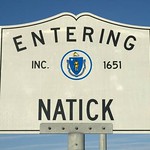
A long time ago, I was solving this puzzle and got stuck at an unguessable (to me) crossing: N. C. WYETH crossing NATICK at the "N"—I knew WYETH but forgot his initials, and NATICK ... is a suburb of Boston that I had no hope of knowing. It was clued as someplace the Boston Marathon runs through (???). Anyway, NATICK— the more obscure name in that crossing—became shorthand for an unguessable cross, esp. where the cross involves two proper nouns, neither of which is exceedingly well known. NATICK took hold as crossword slang, and the term can now be both noun ("I had a NATICK in the SW corner...") or verb ("I got NATICKED by 50A / 34D!")