Achilles' most notable feat during the Trojan War was the slaying of the Trojan prince Hector outside the gates of Troy. Although the death of Achilles is not presented in the Iliad, other sources concur that he was killed near the end of the Trojan War by Paris, who shot him with an arrow. Later legends (beginning with Statius' unfinished epic Achilleid, written in the 1st century AD) state that Achilles was invulnerable in all of his body except for one heel, because when his mother Thetis dipped him in the river Styx as an infant, she held him by one of his heels. Alluding to these legends, the term "Achilles' heel" has come to mean a point of weakness, especially in someone or something with an otherwise strong constitution. The Achilles tendon is also named after him due to these legends. (wikipedia) (my emph.)
• • •
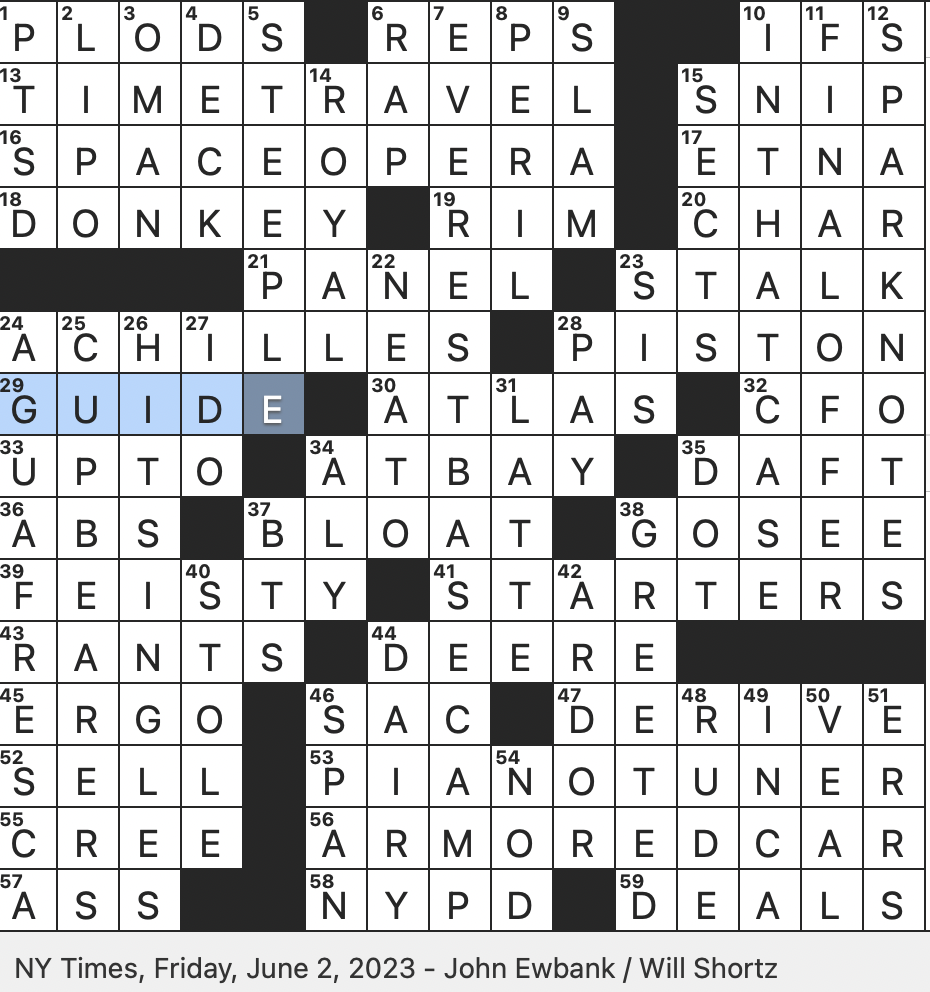
This one was pretty FEISTY, with lots of lively fill and some sharp clues. Started in a dismal place with that 1-Across answer, oof (1A: Police officers, in British slang). I guess that's "original" fill but it was the only thing in the grid that was totally unknown to me, and my general reaction to cop content is "less, please" (instead we get more at the bottom of the grid, with the NYPD next to a militarized ARMORED CAR). Sounds like PLODS is derogatory. Hard to imagine how such an ugly-sounding lump of a word could be anything but. Definition I'm reading now says yes, it is derogatory, implying "dull" and "slow." Apparently the term DERIVEs from "PC (Police Constable) Plod," a character in Enid Blyton's "Noddy" stories. I'm gonna step away from this rabbit hole before I fall in... whatever its implications, wherever it comes from, PLODS is not exactly the tone-setter you want at 1-Across. Well, certainly not the tone-setter *I* wanted. I'm here for a good time and you're giving me sneering foreign slang for cops? Harrumph. But as I say, this was actually the puzzle nadir. It all went up from here (in a good way) until it all went down (also in a good way) at EVEREST BASE CAMP (7D: It's an uphill climb from here). Ironically, this answer didn't climb; instead, thrillingly, it plummeted:
I was already whipping around from all the SPACE OPERA TIME TRAVEL, and then whoosh, down down down. I love that this answer goes from peak to base. It seems to be ... enacting itself, somehow. I was not at all certain that EVEREST BASE CAMP was right when I first plunked it down. I felt like the answer was doing recon, stretching out into the vast unknown of the empty grid, trying to detect ... other signs of life? Fellow answers? And sure enough, the Everest answer picked up PANEL NEATO ATLAS in quick succession, though AT BAY was the answer that really locked me in, confirming the "B" in the part I was least sure about (BASE CAMP). The puzzle unfolded from there, with EVEREST BASE CAMP acting as a kind of ... base camp? ... from which I went out and to which I returned. A bunch.
Not sure why, but the NW and SE corners played way easier than their counterparts. I mean, the NE and SW weren't terribly hard either, but they definitely took a bit of effort to break into. I got PISTON to go into the NE corner (28A: Any of the "Bad Boys" in the 1980s-'90s N.B.A.) (the Detroit Pistons were a late-80s powerhouse), but I couldn't get STARTERS to come in from below and had no idea what was going on with that STALK clue (23A: Something out standing in its field?) (me: "... hay STACK?"), so I had to break flow and jump into the unknown, hitting those short four-letter crosses in hopes that they would give me traction. Luckily, CHAR and ETNA were accurate and gave me needed traction. Then I looked at the long Downs up there and realized I didn't need that traction after all, in that SPARK NOTES was a total gimme that I could've gotten with no help at all—an extremely easy answer for an English teacher (12D: Website with a No Fear Shakespeare section). Poor SPARK NOTES. I'm guessing ChatGPT is gonna really eat into your "how do we do our homework without doing the actual reading?" business. (I think SPARK NOTES and the like can be valuable, but only for those who actually bothered to read in the first place).
The SE corner was harder, mainly because I totally forgot about the connection between ACHILLES and the Styx. I talk about ACHILLES all the time, every semester when I teach Virgil's Aeneid (ACHILLES isn't really in it, though his horrible son has a memorable, violent scene). But with -LLES in place I couldn't think of anything, LOL. Seems preposterous in retrospect, but I had nothing. My brain was like "look, if it's not ... I don't know, the SEYCHELLES? ... I can't help you." I was having trouble getting into that corner via FEISTY as well—hard to see from just the back end. Again, I had to jump in and hack at short crosses, and again, my first two guesses came up gold (CREE, SELL), but the thing that really locked me in down there was "Post hoc, ERGO propter hoc" (causal fallacy). Abandoned by ACHILLES but saved by ERGO, that was my SW experience. The classical vibe keeps going down there with CUP BEARERS, a term I've heard only in relation to Zeus / Jove / Jupiter (25D: Attendants at a saturnalia). Specifically, it's the term used for Ganymede, the boy whom Zeus abducted to serve as his "cup bearer" (as well as lover) in Olympus (Zeus, notoriously shaky on things like sexual propriety and consent). I didn't know "saturnalia" had CUP BEARERS. Turns out I'm confusing "saturnalia" and orgies. They're both classical in origin and involve ... reveling, of sorts, so I forgive myself the confusion. Anyway, CUP BEARERS is a pretty tough answer, I think, but the puzzle as a whole, not that tough. Very doable. And fun. See you tomorrow.
Relative difficulty: Medium-Easy (for me, a brutal four square section ... and, once I worked that out, a cakewalk)
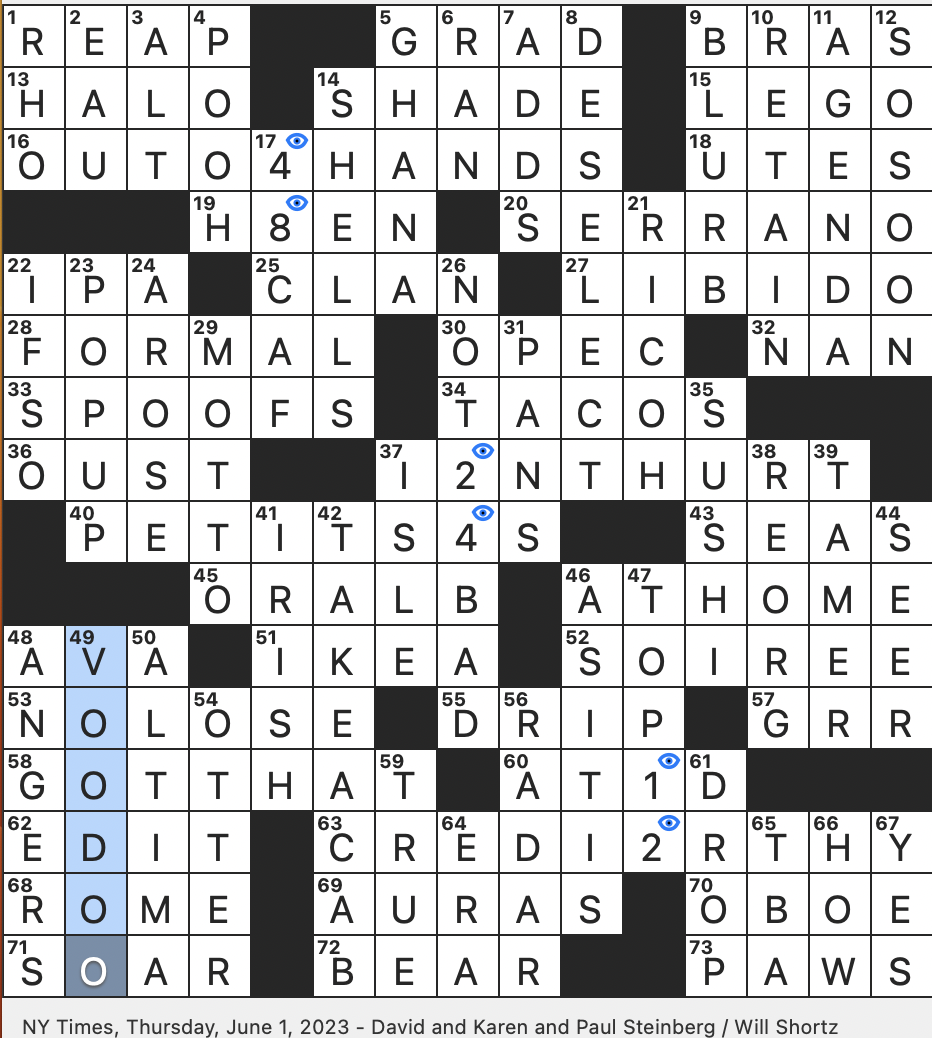
THEME: Reducing Fractions — The word "HALF" (in three Down answers) is replaced (over two squares) with a fraction representing "HALF" (with numerator/denominator reduced by HALF each time: 4/8, 2/4, 1/2); in the Across answers, the numbers in the fractions function as letters (e.g. "-four-," "-eight-," etc.). Theme answers (Downs / fractions):
17D: Coffee with less kick (4/8 CAF, i.e. HALF CAF)
26D: Pretty darn good (NOT 2/4 BAD, i.e. NOT HALF BAD)
47D: Inning part when the visiting team bats (TOP 1/2, i.e. TOP HALF)
Theme answers (Acrosses / letters):
16A: Not up to us (OUT OF OUR HANDS)
19A: Increase the intensity of (HEIGHTEN)
37A: Doctor's reassurance before a shot ("IT WON'T HURT")
40A: Small, fancy confections (PETITS FOURS)
60A: Made amends (ATONED)
63A: Reliable, to a lender (CREDIT-WORTHY)
Word of the Day: PETITS-FOURS (40A) —
A petit four (plural: petits fours, also known as mignardises) is a small bite-sized confectionery or savory appetizer. The name is French, petit four (French pronunciation: [pə.ti fuʁ]), meaning "small oven". // In 18th and 19th century France, gas ovens did not exist. Large brick (Dutch design) ovens were used, which took a long time to heat up to bake bread, but also to cool down. Bakers used the ovens during the cooling process, taking advantage of their stored heat, for baking pastry. This was called baking à petit four (literally "at small oven"), a lower temperature which allowed pastry baking. // Petits fours come in three varieties:
In a French patisserie, assorted small desserts are usually called mignardises, while hard, buttery biscuits are called petits fours.
• • •
Huge "aha" with this one, though it doubled as a huge "D'oh!" because once I got the gimmick (after much staring and quizzical head-tilting) I realized I'd been reading one of the clues wrong. For me the most vicious part of this puzzle was the fact that DECAF fit perfectly at 17D: Coffee with less kick. The second most vicious part was the fact that HIKE fit at 19A: Increase the intensity of, and the third most vicious was the clue on SHELLS (14D: Racing boats), which I thought were SCULLS (Is That A Thing!?!?! ... oh, %#$&@! It Is!! Cruel). I could see that 16A: Not up to us wanted to be OUT OF OUR HANDS, but with DECAF and SCULLS wanting in on the action, I had OUT O--ANDS and couldn't visualize how any of that was gonna work. And underneath that I had H--N for 19A: Increase the intensity of and no idea what I was supposed to do with that. Kept trying to pull GHANA (5D: Major exporter of gold and cocoa) but GHANA wasn't ghana go anywhere, so... yeah. Eventually I decided it was a "FOUR" rebus, somehow, and I shifted SCULLS to SHELLS. This allowed me to finally see the "8" in HEIGHTEN, right under the "4" in OUT OF OUR HANDS, but I still had this dumb moment of "Wait, if it's DECAF ... how does 4 over 8 equal "DE" ... D = 4? E = 8? This isn't some phone keypad thing, is it ... no, that doesn't work. I don't get it, why would you put HALF over CA- ... oh for &^#$%'s sake." It's coffee with less kick, not no kick. So ... HALF CAF. Allow me to repeat: D'oh! After that, the rest of the puzzle (and I still had a long way to go) was a breeze.
I wonder if solving on paper would've made this easier. I think I could've maybe visualized the whole number rebus aspect a little better with pencil and paper. But as I say, once the "half" gimmick dropped, there wasn't much left to this one, except to discover how the remaining "halves" were going to play out, although at that point I guess I didn't know they were all going to be halves. I suppose other fractional amounts were still possible. But I at least knew to look for number rebuses in the Across answers, and it's not too hard to see the number in PETITS FOURS, which helped me change NOT SO BAD (?) to the much better NOT 2/4 i.e. HALF BAD. And then I came at TOP 1/2 i.e. HALF from above, with the TOP already in place before I ever looked at the clue, so no problem there—just needed to see what numbers were going to be involved, and ATONED made that clear quickly. I think this theme is ingenious, even if it meant that the puzzle played really, really unevenly (much struggle up front, virtually none thereafter). The fractions are handed gracefully—more gracefully than I require, frankly. No need to make your rebus gimmick this symmetrical, but if symmetry's your thing, here you go. I was definitely looking for another HALF somewhere in the grid, but I guess the choice was made to keep it simple, symmetrical, clean—so those NE and SW corners are allowed to remain fraction-free, and since they're more than solid, I appreciate that. Love the chili pepper over LIBIDO (hot!), and I love the colloquial quality of "GOT THAT?" I don't loveTAKE A CAB, but of all the EAT A SANDWICH-type answers, TAKE A CAB is probably among the best, in that it actually seems like a legit standalone phrase. So we've got a very clever theme and a highly polished grid. Good enough for me.
I feel like some contingent of solvers are going to have trouble with PETITS FOURS, either with not really knowing what they are, or not knowing how plural French spellings work, or ... something. But I don't see much else (outside the entire theme concept!) to give solvers too much trouble today. There are hardly any proper nouns from pop culture (of any era). In fact ... there are none? I mean, SPOOFS is clued via "Airplane!" and "This is Spinal Tap," and I guess you could consider POOH "pop culture" if you wanted, but this puzzle just doesn't have trivia of the sort that is likely to leave anyone generationally baffled (see yesterday's BEASTIE BOYS, lol). My mistakes were all fairly petty. I wanted UTAH before UTES (18A: Salt Lake City team), which left me briefly wondering why a chair might need UGANDA (11D: Something a chair needs = AGENDA). I wrote in LEST for some reason at 22D: "Should that be the case ..." ("IF SO...") (four letters, "S" in place ... it seemed plausible in the moment). 32A: Grammy equivalent is a wicked clue, in that you're sure to think "award" before "grandmother." NAN came as a surprise there, but luckily crosses were easy. I liked the clue on DESELECT (8D: Turn off, digitally) because "digitally" seemed to work in two ways ("online," "with your fingers"). I don't really get the HOW and YES clues at the end (66D: Good question / 67D: Good answer). That is, I don't know why they're "good." Is this some kind of meta-commentary, like "HOW does this puzzle even work?" and "YES! I finally figured it out!"? Maybe you have better ideas. Let me know.
It's a new month—time to highlight the best NYTXW puzzles of last month (two themed puzzles, and one themeless). So here it is, the Best of May 2023:
Themed: Catherine Cetta, "SAY CHEESE" (Mon. May 8); David J. Kahn, "CAPITAL / GAINS" (Thu., May 4)
Themeless: Spencer Leach (PRIDE PARADE / POLE DANCE / PROMO CODE / BORED TO DEATH) (Sat., May 13)
See you tomorrow.
Signed, Rex Parker, King of CrossWorld
P.S. OK some of you seem to have gotten a dark line between numerators and denominators but I cannot figure out what solving format was involved. If you *did* have a dark line, what solving format were you using?
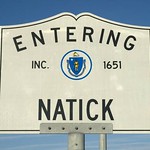
A long time ago, I was solving this puzzle and got stuck at an unguessable (to me) crossing: N. C. WYETH crossing NATICK at the "N"—I knew WYETH but forgot his initials, and NATICK ... is a suburb of Boston that I had no hope of knowing. It was clued as someplace the Boston Marathon runs through (???). Anyway, NATICK— the more obscure name in that crossing—became shorthand for an unguessable cross, esp. where the cross involves two proper nouns, neither of which is exceedingly well known. NATICK took hold as crossword slang, and the term can now be both noun ("I had a NATICK in the SW corner...") or verb ("I got NATICKED by 50A / 34D!")
.png)