.png)
Otis's love interest on Netflix's "Sex Education" / WED 9-10-25 / Quaint term of address for a noblewoman / Willow whose twigs are used in basketry / Mesh for securing items in transport / Heinz bottle blueprint, say / One of Daniel Radcliffe's paparazzi, say / Skimpy serving of foie gras, say / The biggest and most loving of hugs, say / Madness punny name for a barbershop / Stereotypical name for a Dalmatian / Physicist who built upon Volta's work
Wednesday, September 10, 2025
Constructor: Cole Vandenberg and Harit Raghunathan
Relative difficulty: Easy

Theme answers:
- LIVER SLIVER (17A: Skimpy serving of foie gras, say)
- POTTER SPOTTER (23A: One of Daniel Radcliffe's paparazzi, say)
- KETCHUP SKETCH-UP (35A: Heinz bottle blueprint, say)
- MOTHER SMOTHER (45A: The biggest and most loving of hugs, say)
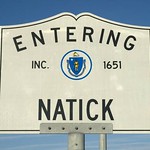
- TATER STATER (53A: Idahoan, say)

Georg Simon Ohm (/oʊm/; German: [oːm] ⓘ; 16 March 1789 – 6 July 1854) was a German mathematician and physicist. As a school teacher, Ohm began his research with the new electrochemical cell, invented by Italian scientist Alessandro Volta. Using equipment of his own creation, Ohm found that there is a direct proportionality between the potential difference (voltage) applied across a conductor and the resultant electric current. This relation is known as Ohm's law. // Ohm's law states that the electric current through a conductor between two points is directly proportional to the voltage across the two points. Introducing the constant of proportionality, the resistance, one arrives at the three mathematical equations used to describe this relationship:

where I is the current through the conductor, V is the voltage measured across the conductor and R is the resistance of the conductor. More specifically, Ohm's law states that the R in this relation is constant, independent of the current. If the resistance is not constant, the previous equation cannot be called Ohm's law, but it can still be used as a definition of static/DC resistance. Ohm's law is an empirical relation which accurately describes the conductivity of the vast majority of electrically conductive materials over many orders of magnitude of current. However some materials do not obey Ohm's law; these are called non-ohmic.
• • •

[Ruby Blue had an album called Glances Askances but I can't find the song I want from it so I'm playing a different song from a truly great album, Down from Above—I actually think this song was *also*. on Glances Askances, maybe in a different version; you don't need to know any of this ... anyway, just know there was a crossword "logic" that got me here]
So the fill skewed stale. I wish I had better news about the theme. I really do. But I don't. It's just a word ... and then that word, repeated, but with an "S" on its front. It's the kind of theme that I came up on, a very 30+-years-ago theme. Trying to squeeze a lot of "wackiness" out of a very small and ultimately unjuicy concept. The theme answers go all kinds of ways, none of them good. Well, one of them good: I really like TATER STATER for some reason. It's snappy. Concise. It lands. The others ... er, not as entertaining. There's something kind of grotesque about LIVER SLIVER, esp. as its clued via foie gras, a "delicacy" achieved only through a force-feeding process many regard as cruel. Daniel Radcliffe is not, himself, Harry Potter, so the clue makes little sense, and Radcliffe has done his damnedest to distance himself from the hateful woman who created Potter—I don't know why the NYTXW can't do the same, but clearly it cannot. I have no idea what a SKETCH-UP is. I know what a SKETCH is. I know what a "mock-up" is. SKETCH-UP, pfft, don't know it (it seems to be 3D modeling software from Google? if that's a very well-known thing, and that's what's intended here, then I apologize for my ignorance). There's nothing in the MOTHER SMOTHER clue to suggest "mother" at all and further, ick—the answer itself evokes not love but murder—matricide? infanticide?—or at a minimum mild suffocation. In short, the concept was flimsy and the execution awkward. The theme also makes for another excessively easy solve (once you know the concept, you just need a little of the front half of the answer to be able to write the whole thing in).
What else?:
- 10D: Mesh for securing items in transport (CARGO NET) — real trouble with the "G" here. Just couldn't parse CAR-ONET and thought the "mesh" might have a technical term, namely CARBONET!
- 6A: Rock, for one (COMIC) — the Rock in question is Chris Rock.
- 20A: Otis's love interest on Netflix's "Sex Education" (MAEVE) — I watched and liked the first season of this show, and then gave up on it in season two. I had absolutely no memory of any of the characters' names. This seems like an obscure answer today, esp compared to the rest of the highly unobscure fill. But you can get it from crosses pretty easily.
- 4D: "Richard of York gave battle in vain," for the colors of the rainbow (MNEMONIC) — a great word, but why on earth would you use *that* as your rainbow MNEMONIC when Roy G. Biv exists. Who does that? 1950s British schoolboys?!?!? Roy G. Biv. So concise. So useful. I used it literally just yesterday (when trying to explain a cryptic crossword clue to my wife—specifically, how the "red" part of the clue indicated "R"). Richard of York! "Gave battle"? Yeesh. Make it easy on yourselves, people of Britain!
[Follow Rex Parker on BlueSky and Facebook and Letterboxd]
=============================
❤️ Support this blog ❤️:
✏️ Upcoming Crossword Tournaments ✏️
- Midwest Crossword Tournament (Chicago) (Sat., Oct. 4, 2025)
- Finger Lakes Crossword Competition (Ithaca) (Sat., Oct. 18, 2025)
📘 My other blog 📘:
- Pop Sensation (vintage paperbacks)